Smart Guide to Short Term Rental Insurance for Pennsylvania Hosts

Smart Guide to Short Term Rental Insurance for Pennsylvania Hosts

Running a short-term rental in Pennsylvania opens doors to steady income, but it also exposes you to risks that standard homeowners insurance won’t cover. Your regular policy explicitly excludes commercial activity like guest rentals, leaving you vulnerable to liability claims and property damage costs.

At Eric L. Ash Insurance Agency, we’ve seen hosts face unexpected gaps in coverage that cost them thousands. The right short-term rental insurance fills those gaps and protects both your property and your income stream.

What Your Short-Term Rental Insurance Actually Protects

Liability Protection Shields You From Guest-Related Claims

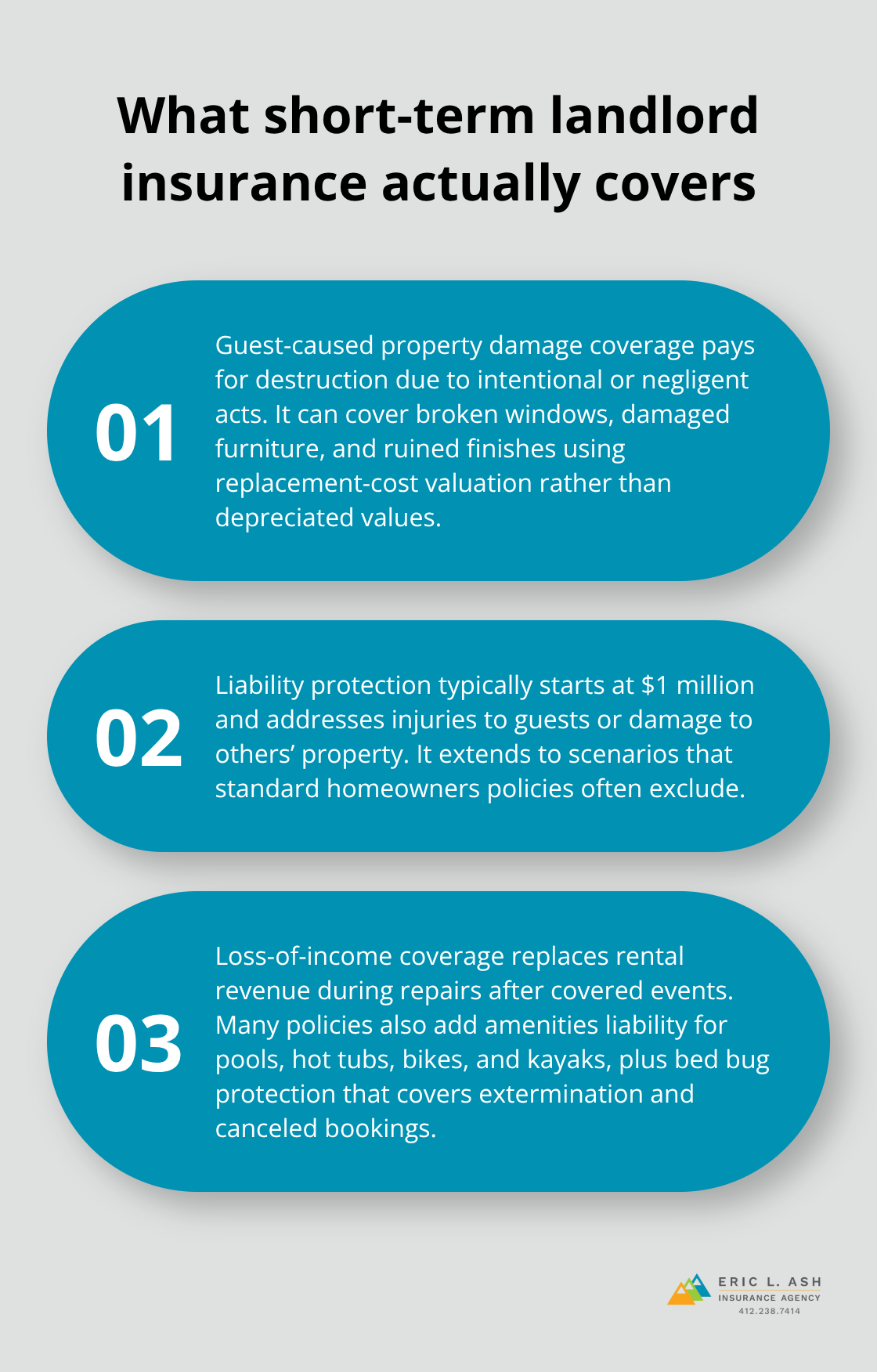
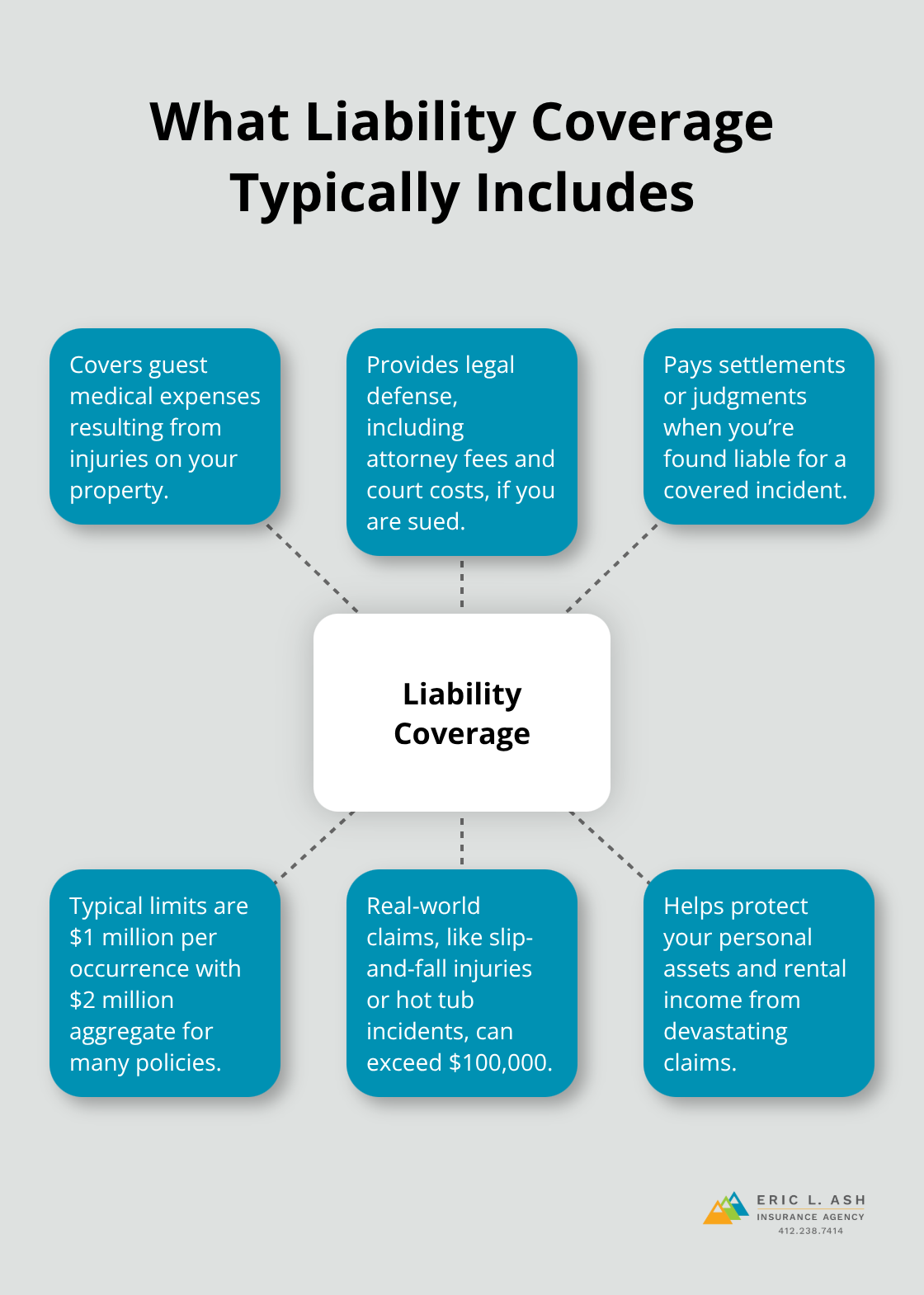
Liability protection defends you when a guest suffers an injury on your property or causes damage to someone else’s belongings. Most policies offer $1 million in coverage per occurrence, with standard limits including $2 million aggregate, which matters because a single slip-and-fall claim or a guest’s visitor injured in your hot tub can easily exceed $100,000 in medical costs and legal fees. This coverage pays for medical expenses, legal defense, and settlement costs that would otherwise come directly from your pocket.

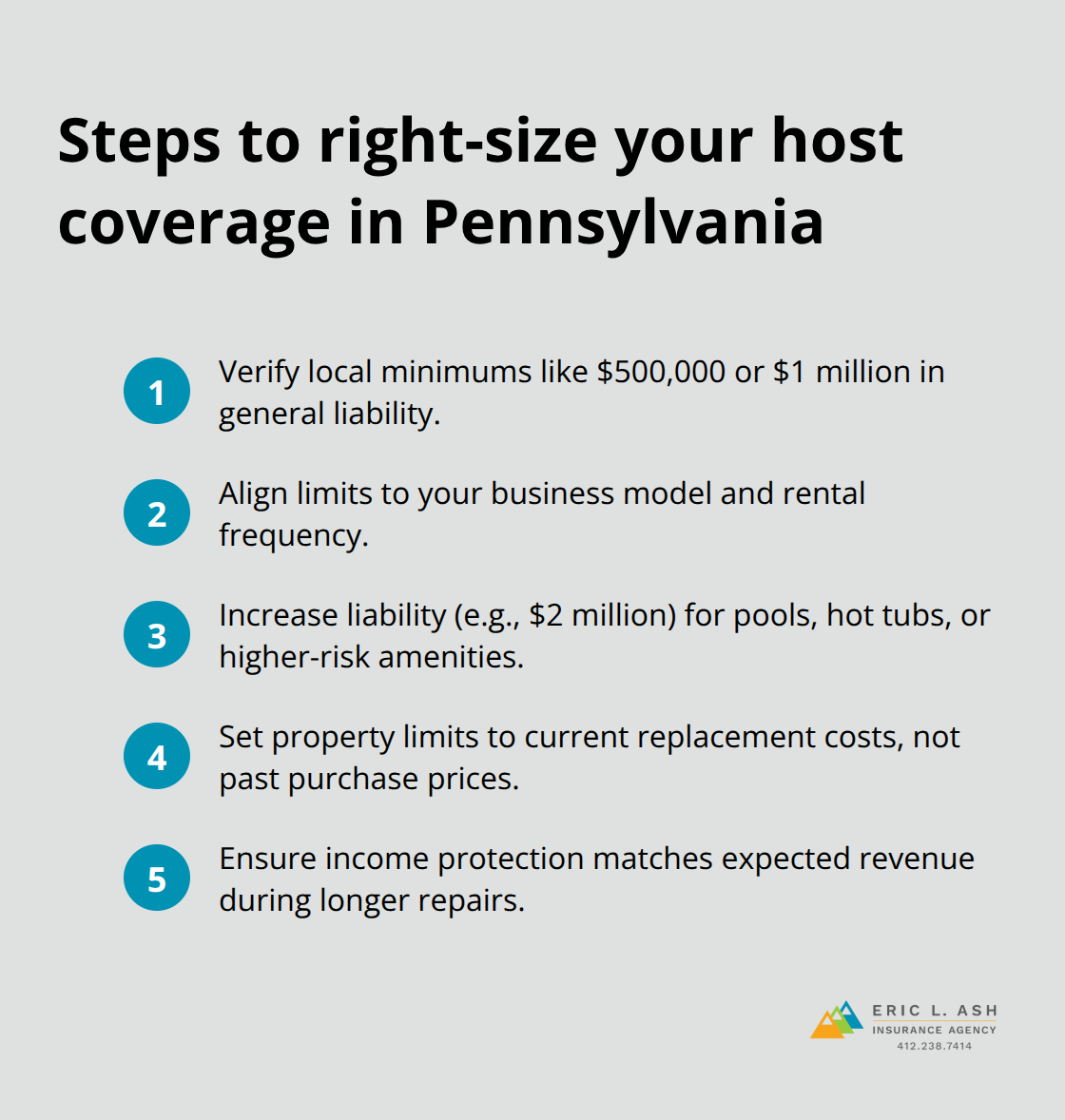
Overview of short-term rental liability coverage components for hosts in Pennsylvania - short term rental insurance

Without it, you face personal financial exposure that can devastate your rental income and personal assets.

Property Damage Coverage Protects Your Physical Investment

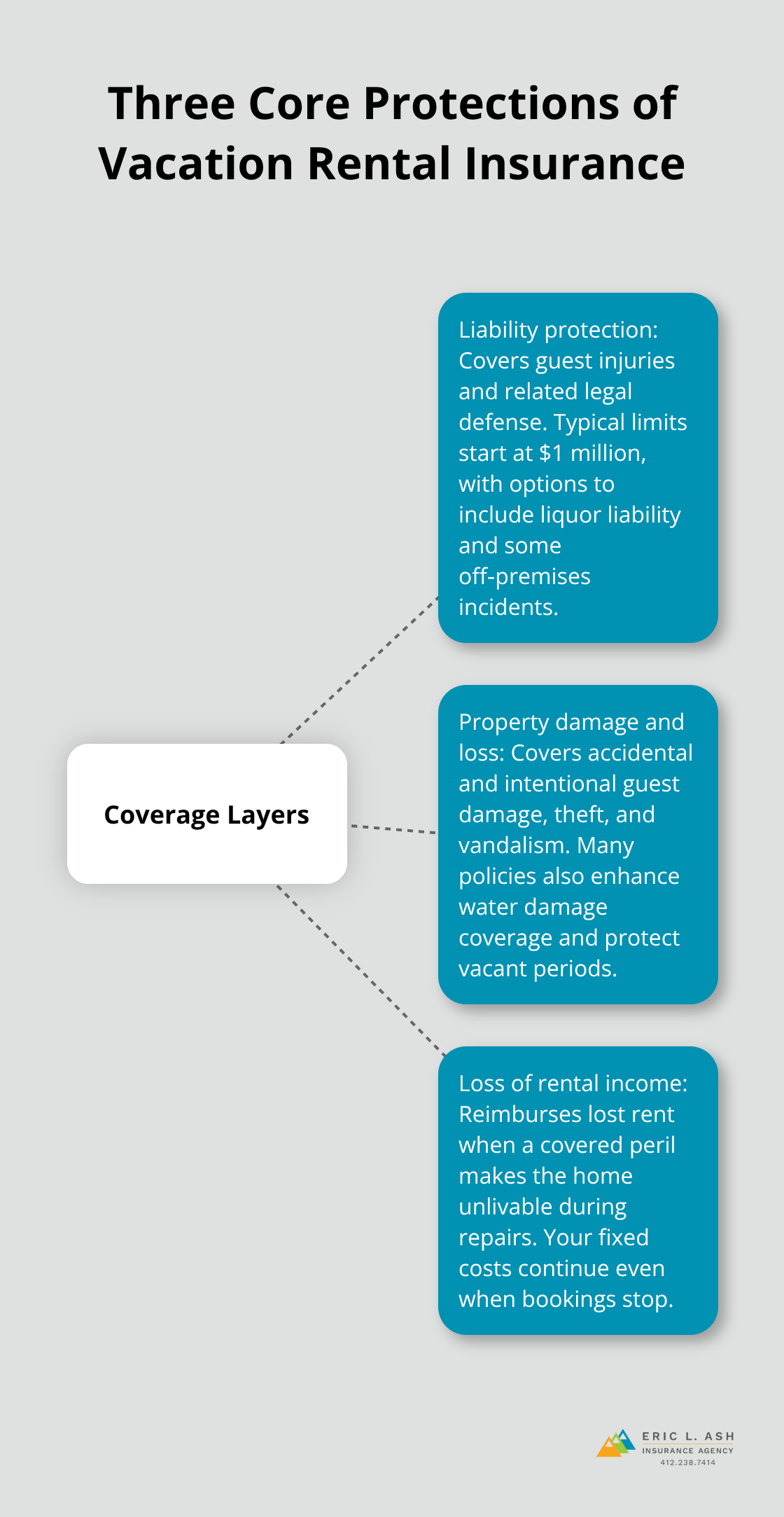
Property damage and loss coverage reimburses you for damage to your furnishings, appliances, and structural elements caused by covered perils like water damage from burst pipes, fire, storms, and vandalism. Water damage from broken pipes and appliance leaks represents the most expensive type of property damage for rental properties, so this coverage directly protects your largest investment. The valuation method matters significantly-replacement cost value policies pay what repairs actually cost, while actual cash value policies deduct depreciation and leave you short. You should always select replacement cost value coverage to avoid substantial out-of-pocket expenses when damage occurs.

Loss of Rent Coverage Maintains Your Cash Flow

Additional living expenses coverage, sometimes called loss of rent, reimburses you for lost rental income when a covered claim makes your property uninhabitable. If a fire forces you to close for three months, this coverage pays the income you would have earned during that period, protecting your cash flow when you need it most. Loss of rent coverage typically pays actual rental income lost with no time limit up to your chosen amount, which differs from homeowners policies that cover temporary living expenses only. This distinction proves critical for hosts who depend on rental income to cover mortgage payments or property expenses.

Tailoring Coverage to Match Your Property’s Needs

A $1 million liability limit protects you adequately for most Pennsylvania properties, though larger homes with pools or hot tubs warrant higher limits. Steadily and other Pennsylvania insurers offer these coverages for rental periods as short as one night, and policies can be tailored to include specific risks or limited coverages based on your property’s needs and your budget. The key is verifying that your chosen policy covers the specific exposures your rental creates, because gaps in coverage leave you personally liable for costs that specialized insurance would otherwise handle. An independent agent can help you assess which coverage options match your property type and guest volume.

Why Standard Homeowners Policies Exclude Rental Activity

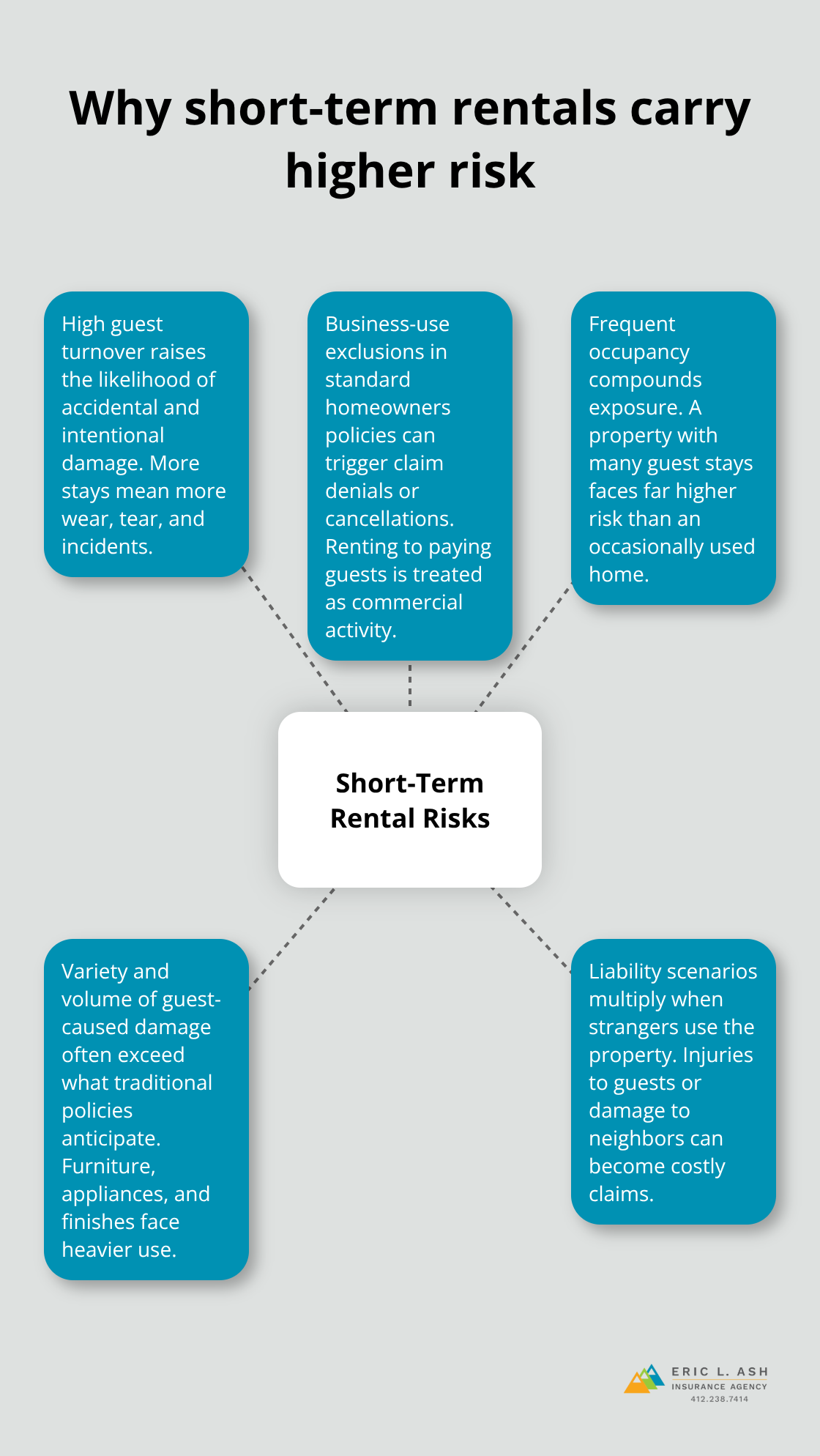
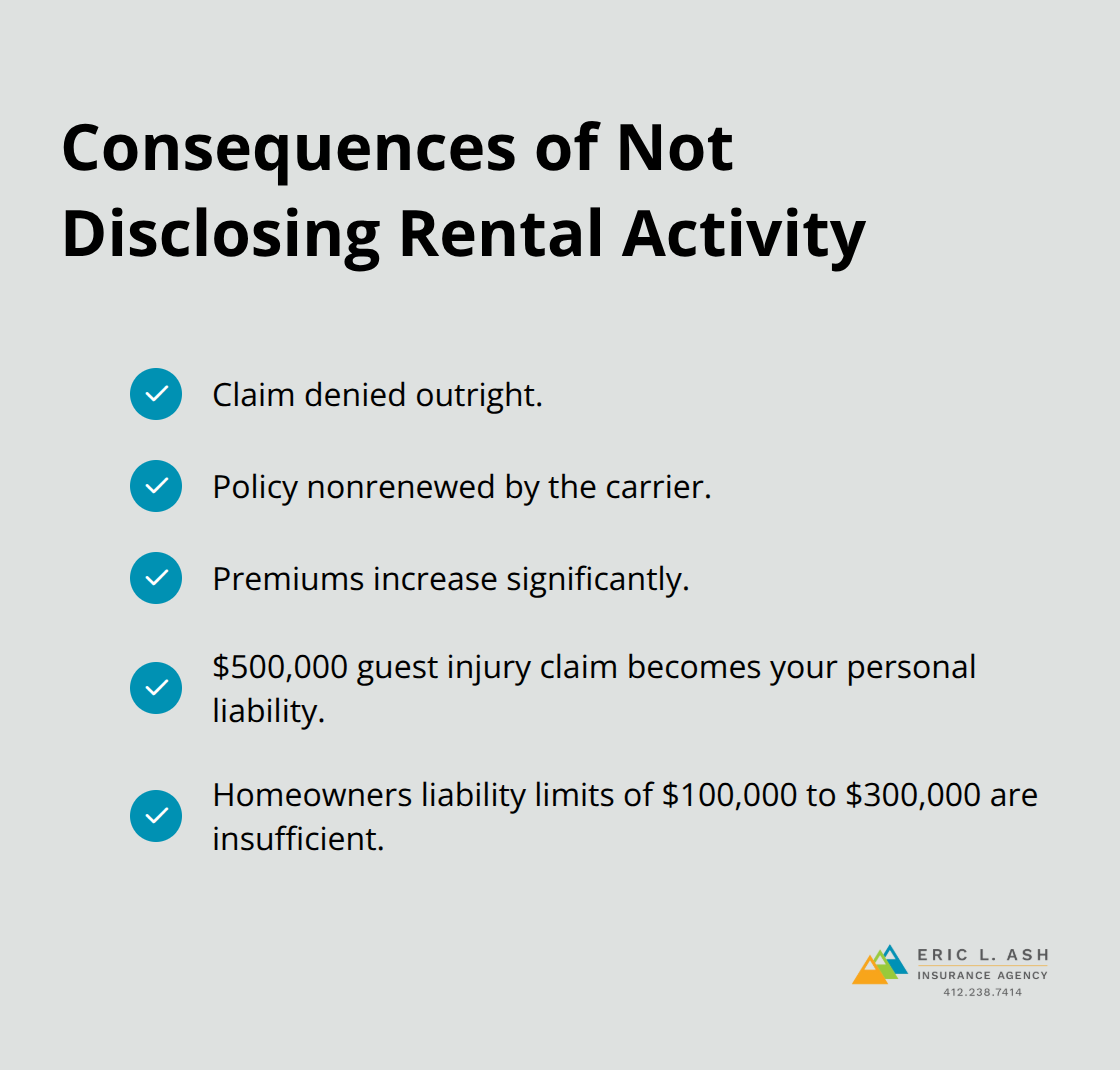
Your homeowners insurance policy contains explicit language that excludes rental activity, and this exclusion exists for a fundamental reason: your insurer priced that policy assuming your home remains your primary residence. When you start accepting guests and collecting rental income, you fundamentally change the risk profile of the property in ways your standard homeowners policy was never designed to handle. Homeowners insurance is designed for owner-occupied properties, not for business use. This means filing a claim related to your rental operation can result in a denial, and some insurers may even cancel your policy once they discover you operate a short-term rental. The financial exposure here is real and immediate-you lose coverage precisely when you need it most.

Guest Liability Falls Outside Standard Coverage

Guest liability represents a specific blind spot in standard homeowners policies. Your regular policy covers you if a family member’s friend slips on your stairs, but it explicitly excludes injuries to paying guests and their visitors. A guest who sustains a serious injury in your rental can pursue a claim against you personally, and without proper coverage, you become personally liable for medical bills, lost wages, and pain-and-suffering damages. Standard homeowners policies also ignore the unique exposures that come with short-term rentals-damage caused by guests who treat your property differently than long-term tenants would, theft of your furnishings and amenities, or property damage from parties and gatherings.

Lost Rental Income Receives Zero Protection

Your homeowners policy provides loss of use coverage for your own temporary housing needs if your home becomes uninhabitable, but it provides zero protection for lost rental income. If a fire makes your property unrentable for two months, your homeowners policy covers your hotel costs while you find alternative housing, but it won’t reimburse the thousands in rental income you forfeit. This gap forces you to absorb that income loss entirely from your own pocket, even though the loss resulted from a covered peril.

Specialized Insurance Closes the Coverage Gaps

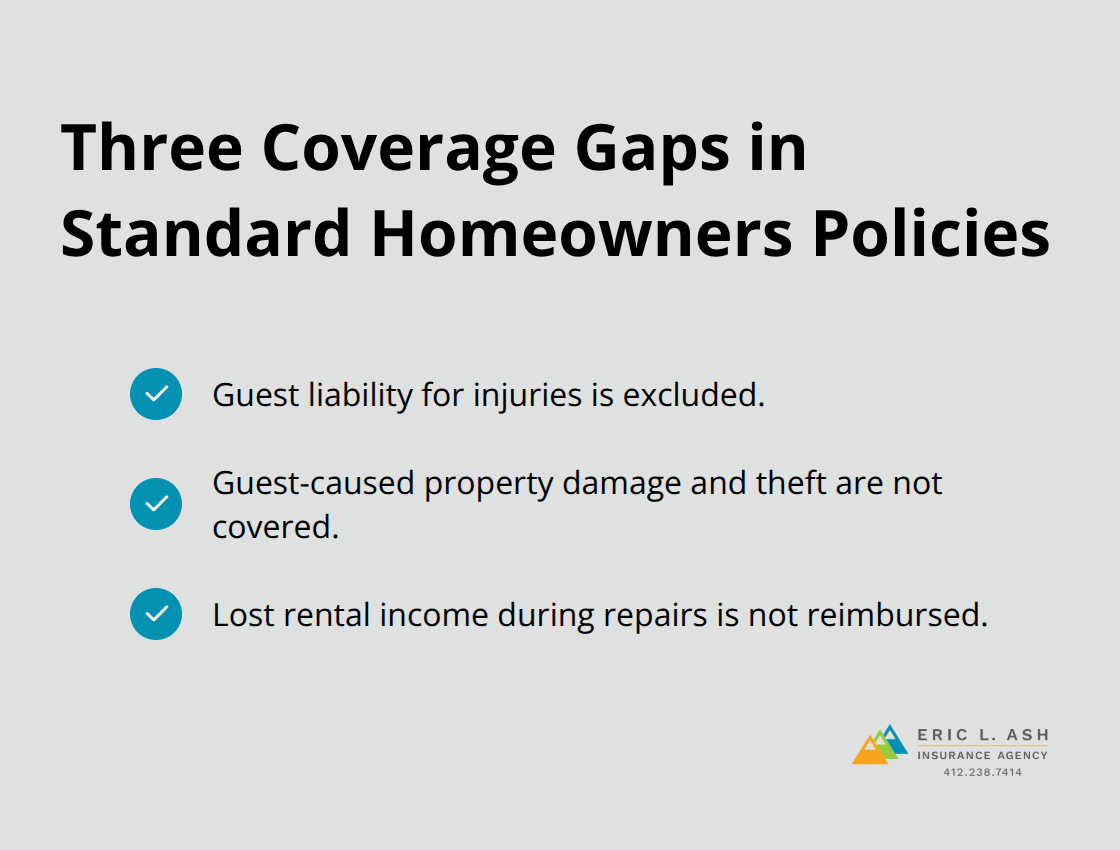
Specialized short-term rental insurance closes all three gaps-it extends liability protection to guests, covers guest-related property damage and your furnishings, and replaces lost rental income when covered claims force a shutdown. Understanding these gaps helps you recognize why your current homeowners policy leaves you vulnerable, and it points directly to the solution: coverage specifically designed for the risks that short-term rental hosts actually face.

Checklist of common gaps standard homeowners insurance leaves for short-term rental hosts

The next step involves selecting the right policy for your Pennsylvania property, which requires assessing your specific situation and comparing what different carriers offer.

Selecting the Right Coverage for Your Pennsylvania Rental

Calculate Your Property’s True Replacement Cost

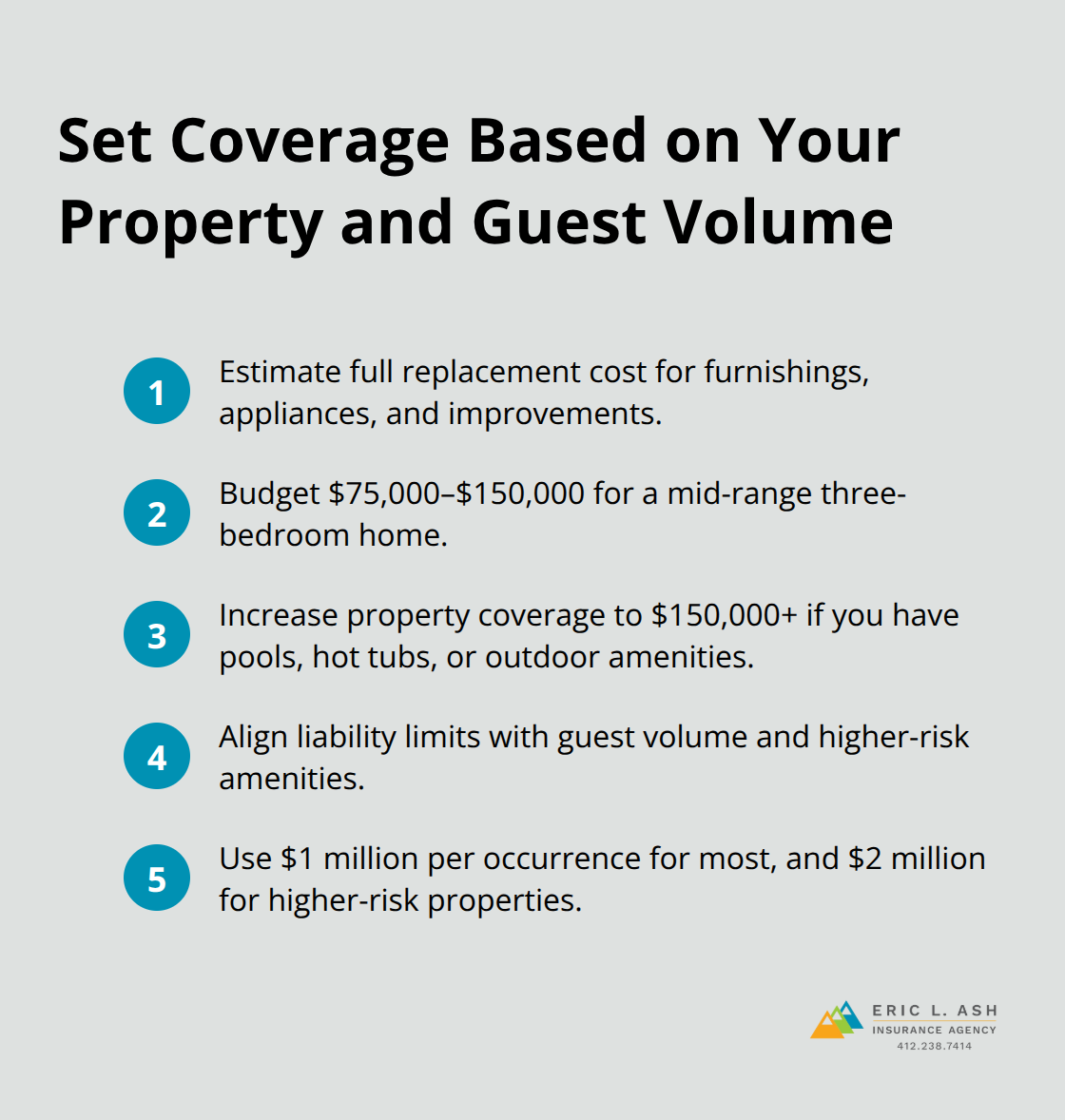
Matching coverage limits to your actual property risk starts with calculating what it would cost to fully replace your furnishings, appliances, and structural improvements if a total loss occurred. A three-bedroom home in the Poconos with mid-range furnishings typically requires $75,000 to $150,000 in property coverage, while a fully equipped property with outdoor amenities like hot tubs or pools warrants $150,000 or higher. Your guest volume matters equally-properties hosting 30 guests monthly face different liability exposures than those hosting 5 guests monthly, and your coverage limits should reflect this frequency.

Compact guide to setting property and liability coverage for Pennsylvania short-term rentals - short term rental insurance

For liability, the industry standard of $1 million per occurrence works for most Pennsylvania rentals, but properties with pools, hot tubs, or accommodations for large groups should carry $2 million.

Set Deductibles and Loss of Rent Coverage to Match Your Financial Situation

Deductibles represent your out-of-pocket responsibility when claims occur, and selecting a $1,000 deductible saves roughly 15–20% on premiums compared to a $500 deductible, though this only makes sense if you can absorb that cost without financial strain. Loss of rent coverage should equal your average monthly rental income multiplied by the number of months you reasonably estimate your property could remain uninhabitable-if you earn $4,000 monthly and want protection for three months of closure, you need $12,000 in loss of rent coverage minimum. This calculation protects your income stream when covered events force temporary shutdowns.

Compare Quotes From Multiple Carriers With Identical Coverage Specifications

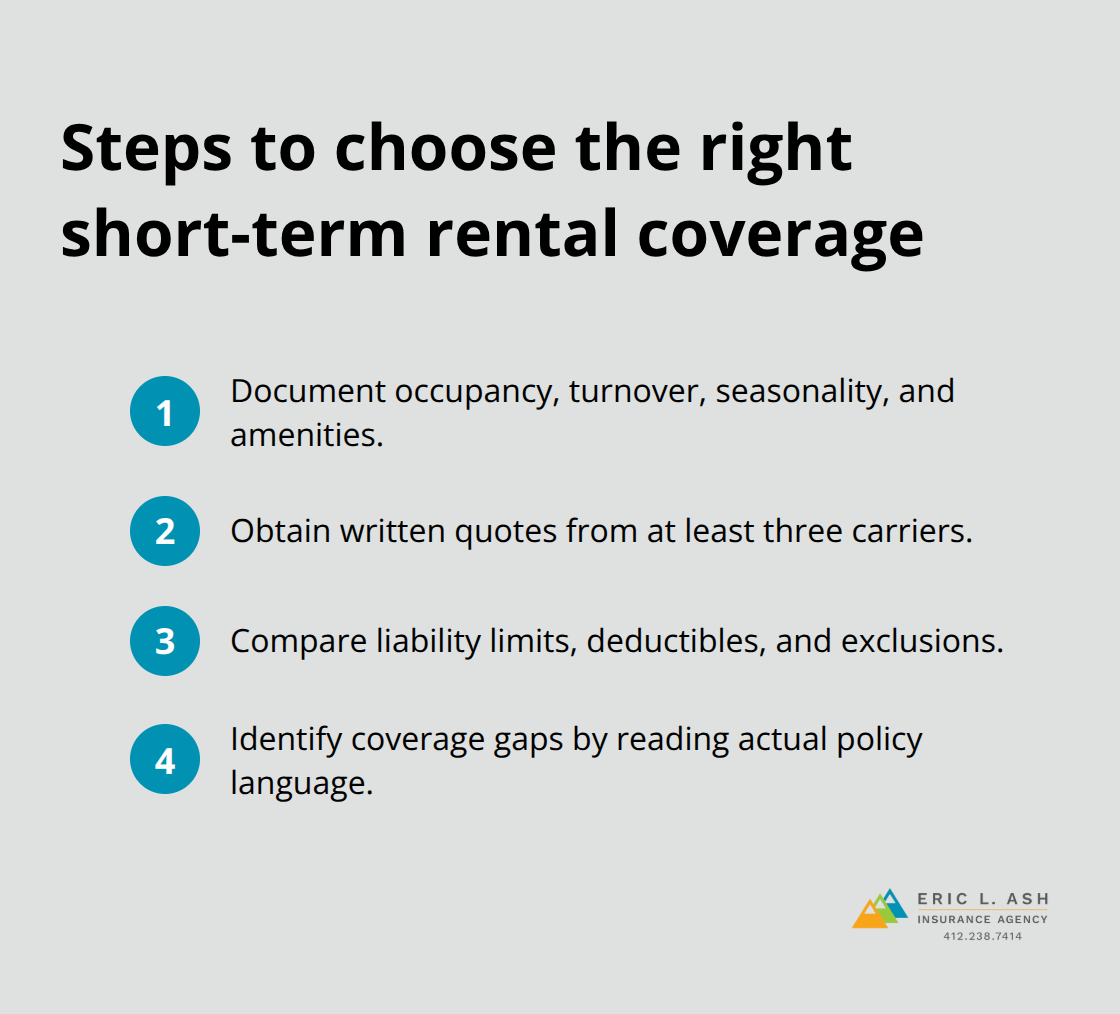
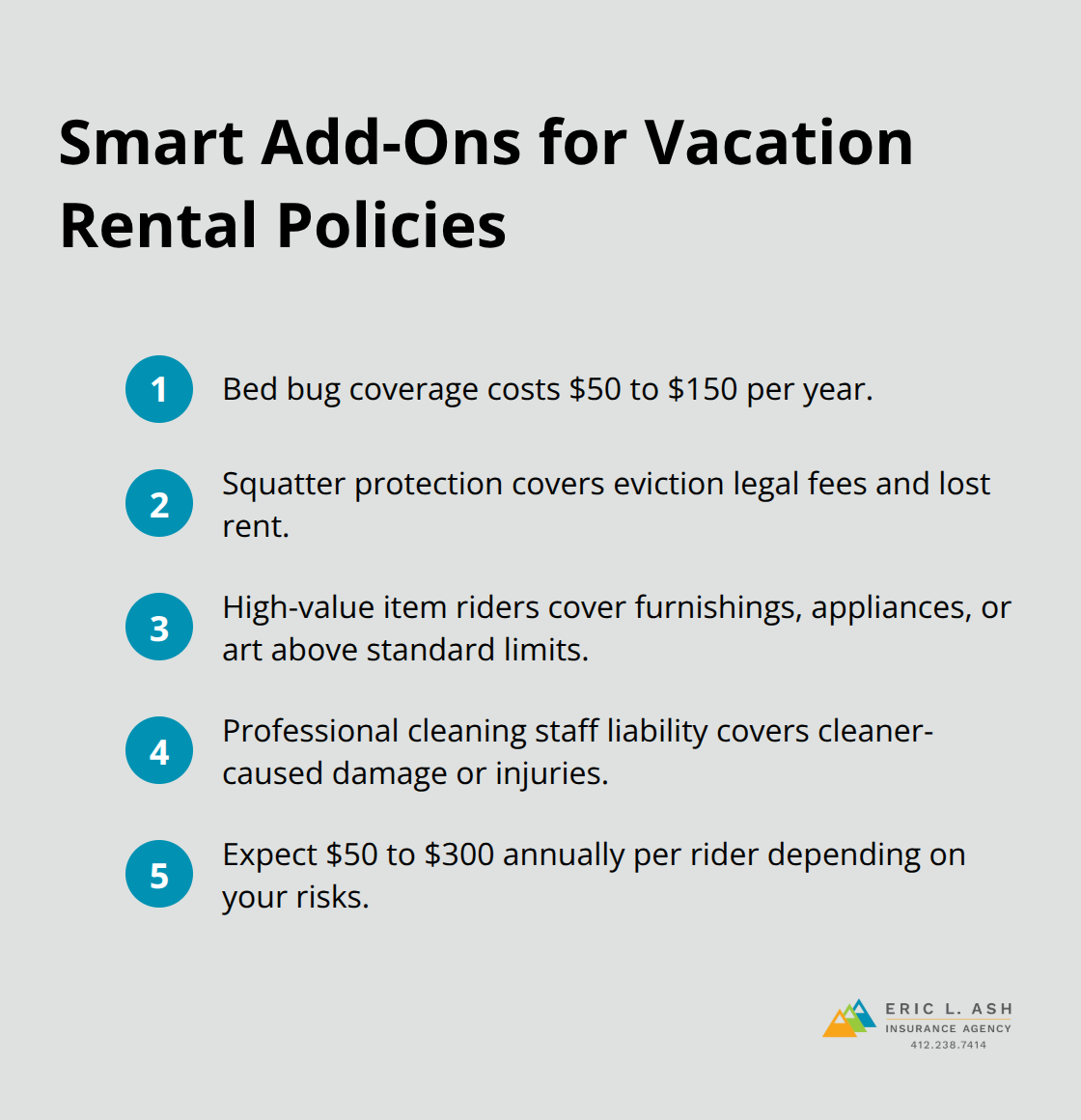
Steadily, Proper Insurance, and Erie Insurance each offer different coverage combinations and price points across Pennsylvania, so comparing quotes from multiple carriers reveals meaningful differences in both cost and what’s actually covered. Request quotes with identical coverage limits and deductibles from at least three carriers, then examine what each policy actually covers beyond the base liability and property protection-some policies include amenities coverage for bikes or kayaks while others exclude them, some cover bed bug and flea liability while others don’t, and some include squatters protection if a guest refuses to leave. Water damage from broken pipes and appliance leaks represents the most expensive property damage claim type for rental properties, so verify that your policy covers both and doesn’t impose limitations on coverage during vacancy periods. Ask each carrier whether your policy covers guest personal property damage, because a guest who damages their own laptop or camera during their stay shouldn’t create liability for you, yet some policies create confusion on this point.

Understand Premium Variation Across Pennsylvania Regions

Premium costs vary substantially-a basic policy might run $600–$800 annually while comprehensive coverage with higher limits can reach $1,500–$2,500 depending on your property location, size, and guest volume. Pennsylvania regions like Philadelphia and Pittsburgh often command higher premiums than rural areas due to higher replacement costs and claim frequency, though this varies by specific neighborhood. An independent insurance agency can obtain quotes from dozens of carriers simultaneously, saving you hours of individual research and revealing options you wouldn’t find by shopping directly with insurers online.

Review Policy Documents and Identify Coverage Gaps

Before binding any policy, read the actual policy document rather than relying on marketing summaries, because exclusions buried in the fine print can eliminate coverage you thought you had. Ask your agent which perils aren’t covered-most policies exclude flood, earthquake, and acts of war, and if your property sits in a flood zone or faces other specific risks, you’ll need separate riders or policies to address those gaps.

Final Thoughts

Standard homeowners insurance leaves Pennsylvania short-term rental hosts exposed to three critical gaps: guest liability claims, property damage from rental activity, and lost income when your property becomes uninhabitable. These gaps exist because your homeowners policy was priced for owner-occupied homes, not income-generating rental operations. A single guest injury or fire that forces a three-month closure can cost you tens of thousands in medical claims, legal fees, and lost rental income that your standard policy won’t cover.

Specialized short-term rental insurance solves these gaps directly by extending liability protection to guests and their visitors, covering property damage caused by rental activity, and reimbursing lost rental income when covered claims force temporary shutdowns. The right policy matches your property’s replacement cost, reflects your guest volume, and includes coverage for the specific exposures your rental creates-whether that’s amenities like hot tubs or the risk of guest damage to your furnishings. You need to calculate your property’s true replacement cost and set liability limits that reflect your guest volume and amenities.

We at Eric L. Ash Insurance Agency work with dozens of carriers to shop multiple markets and deliver competitive rates tailored to your specific rental situation. As a veteran-owned, independent agency serving Pennsylvania, we specialize in short-term rental insurance and can help you assess your property’s actual risk profile and find coverage that protects both your investment and your income stream. Contact us today to compare quotes and close the coverage gaps that leave you vulnerable.

The information provided in this blog is for general informational purposes only and does not constitute legal, financial, or insurance advice. Coverage options, terms, and availability may vary. Please consult with a licensed professional for advice specific to your situation.
Small Business Commercial Auto: Affordable Auto Insurance

Small Business Commercial Auto: Affordable Auto Insurance

Running a small business means managing countless expenses. Your vehicles are essential to operations, but the wrong insurance choice can drain your budget or leave you exposed to serious liability.

We at Eric L. Ash Insurance Agency help small business owners find commercial auto coverage that actually fits their finances. This guide shows you how to secure affordable protection without cutting corners on what matters.

Why Your Business Vehicles Need Commercial Coverage

Personal auto insurance won’t cover your business vehicles, and operating without proper commercial auto coverage exposes you to financial ruin. Most states legally require liability coverage for any vehicle used for business purposes, whether you own it, lease it, or occasionally use a personal vehicle for work. Citations for operating without commercial auto insurance result in fines ranging from hundreds to thousands of dollars, depending on your state, plus potential license suspension and vehicle impoundment. More importantly, if an accident occurs and you lack coverage, you become personally liable for medical bills, property damage, lost wages, and legal fees-costs that can easily exceed six figures and bankrupt a small operation.

The Real Cost of an Uninsured Accident

A single accident involving your business vehicle can destroy your finances. If your driver injures someone, medical expenses for spinal injuries, brain trauma, or permanent disability often exceed $100,000. Property damage claims add up fast: rear-ending another vehicle, hitting a storefront, or damaging commercial equipment can easily cost $20,000 to $50,000 in repairs and liability. Without commercial auto coverage, you pay these costs from your business bank account or personal assets. Courts can garnish your wages, seize equipment, and force you to liquidate inventory to settle judgments. Litigation funding in auto liability cases has also become common, meaning third-party financiers back lawsuits against drivers and businesses, pushing settlements into seven figures. One accident without insurance typically ends small businesses.

What Vehicles Actually Need Commercial Coverage

Service vans, box trucks, food trucks, dump trucks, utility vehicles, and any vehicle regularly used for business operations require commercial auto insurance. This includes company cars used to visit clients, delivery vehicles, vehicles hauling equipment or materials, and even personal vehicles if you use them for regular business activities. Trailers under 3,000 pounds receive automatic liability coverage under most commercial policies, but trailers larger than 3,000 pounds or multi-axle trailers must be specifically listed on your policy to receive physical damage coverage.

Visual guide showing which business-use vehicles require commercial auto insurance in the U.S.

Many small business owners mistakenly assume their personal auto policy covers occasional business use-it doesn’t, and filing a claim for business-related accidents often results in denial and policy cancellation. The distinction is clear: if the vehicle serves a business purpose beyond commuting to a single workplace, you need commercial auto insurance.

Why Personal Policies Fall Short

Your personal auto policy explicitly excludes business use. Insurance companies investigate claims carefully, and they deny coverage when they discover business activity. This denial leaves you uninsured at the exact moment you need protection most. The insurer may also cancel your entire personal policy for misrepresenting the vehicle’s use, leaving you scrambling to find coverage elsewhere. State regulators and insurers take this seriously because business vehicles operate at higher risk than personal commuter cars. Your personal policy simply wasn’t priced or designed to handle the exposure that comes with business operations.

How to Determine Your Coverage Needs

Start by listing every vehicle your business operates or controls. Include company-owned vehicles, leased equipment, and personal vehicles your employees drive for work. Next, identify how each vehicle is used: local deliveries, long-distance hauling, client visits, equipment transport, or service calls all carry different risk profiles. Vehicles with higher mileage, longer routes, or multiple drivers typically cost more to insure because they face greater exposure. Your industry also matters-construction fleets, food service vehicles, and delivery operations all present distinct risks that affect pricing and available coverage options. Once you understand your fleet’s composition and usage patterns, you can work with an independent agent to select the right commercial auto policy.

Finding the Lowest Rates Without Sacrificing Coverage

Get Multiple Quotes to Expose Price Gaps

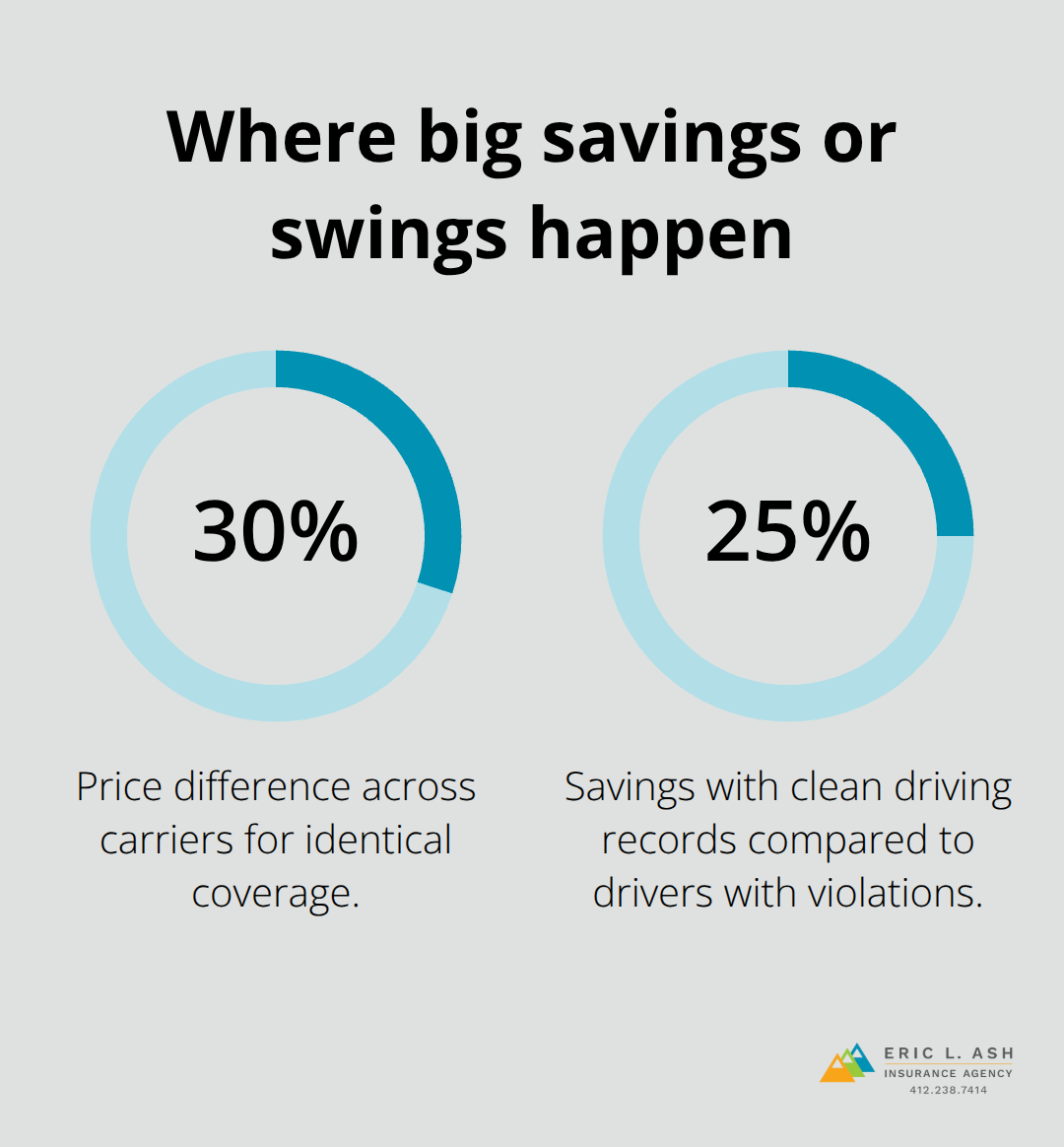
Getting multiple quotes is non-negotiable if you want affordable commercial auto insurance. Most small business owners request one quote, assume that’s the market rate, and move forward-a costly mistake. Commercial auto rates vary dramatically between carriers because each insurer weighs risk differently. One carrier might charge $1,200 annually for a service van with one driver, while another charges $1,800 for identical coverage. The only way to find competitive pricing is to request quotes from at least three to five different insurers. This takes 30 minutes of your time and can save you hundreds of dollars per year.

Steps to get and compare commercial auto insurance quotes for small businesses in the United States. - small business commercial auto

Many carriers now offer online quote tools that let you input your fleet details once and see rates immediately, removing the excuse of inconvenience. When you gather quotes, make sure you compare apples to apples-same coverage limits, same deductibles, same vehicle types. A quote that looks cheaper because it has a $2,500 deductible instead of $1,000 isn’t actually cheaper if an accident forces you to pay more out of pocket. Track each quote in a spreadsheet with the carrier name, premium, coverage limits, deductible amounts, and any discounts applied. This comparison document becomes your negotiating tool.

Stack Discounts on Top of Bundle Savings

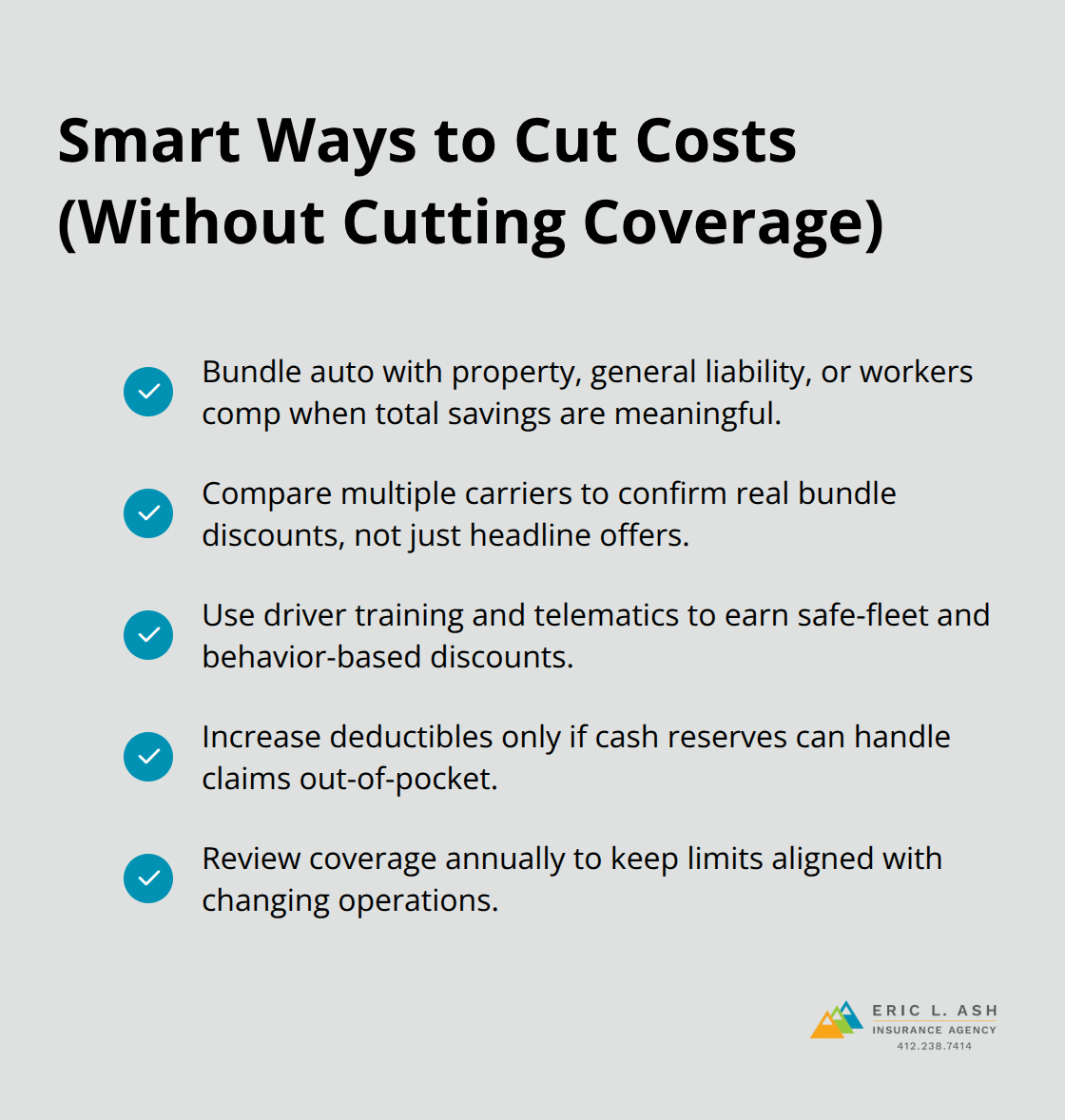
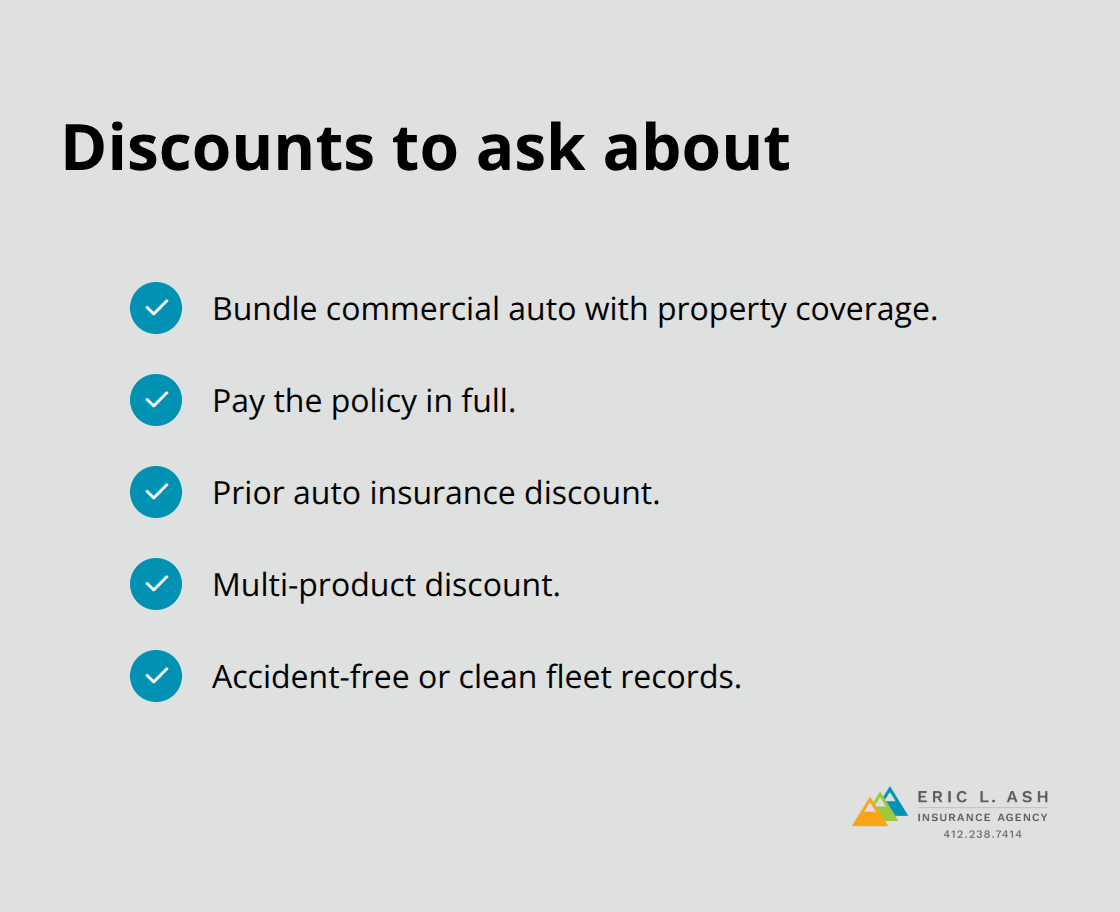
Bundling your commercial auto policy with other business insurance cuts premiums significantly. If you carry general liability, property insurance, or workers’ compensation, adding commercial auto to the same carrier typically saves 10 to 25 percent on your total premium. Carriers offer bundle discounts because they want to consolidate your business and reduce their acquisition costs. A small business paying $800 for general liability and $1,500 for commercial auto separately might pay $1,900 total when bundled with one insurer instead of $2,300 with separate carriers. The math is straightforward: bundling works.

However, bundling only makes sense if the bundled rate is genuinely competitive. Get separate quotes first, then ask carriers what they’ll charge for a complete bundle. If one insurer’s bundled rate is significantly higher than competitors’ individual rates, walk away. Some small business owners also neglect to ask about specific discounts that stack on top of bundled pricing. Safety training discounts, paperless billing discounts, autopay discounts, and claims-free discounts often reduce premiums by another 5 to 15 percent.

Make Driver Safety Your Competitive Advantage

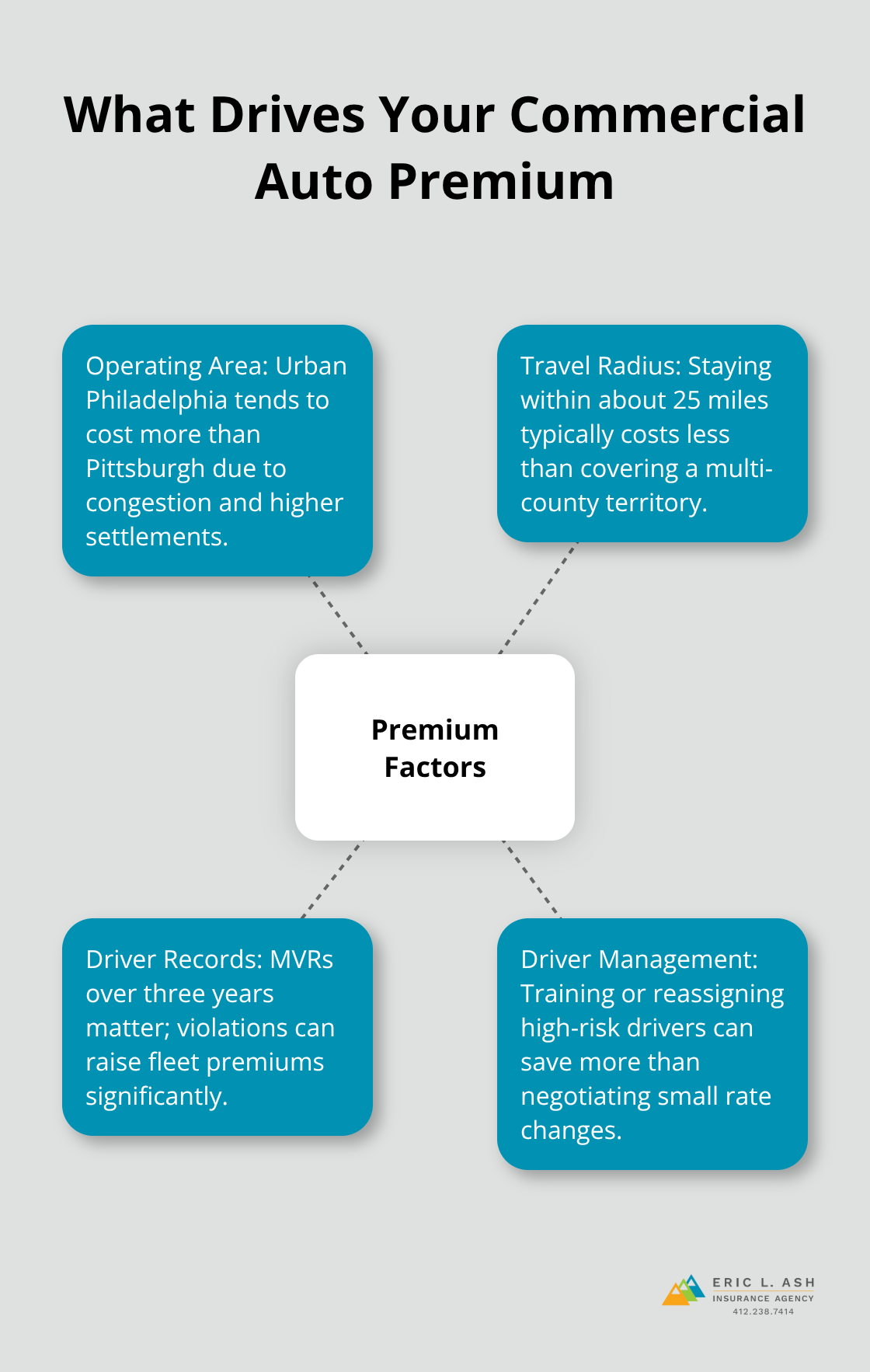
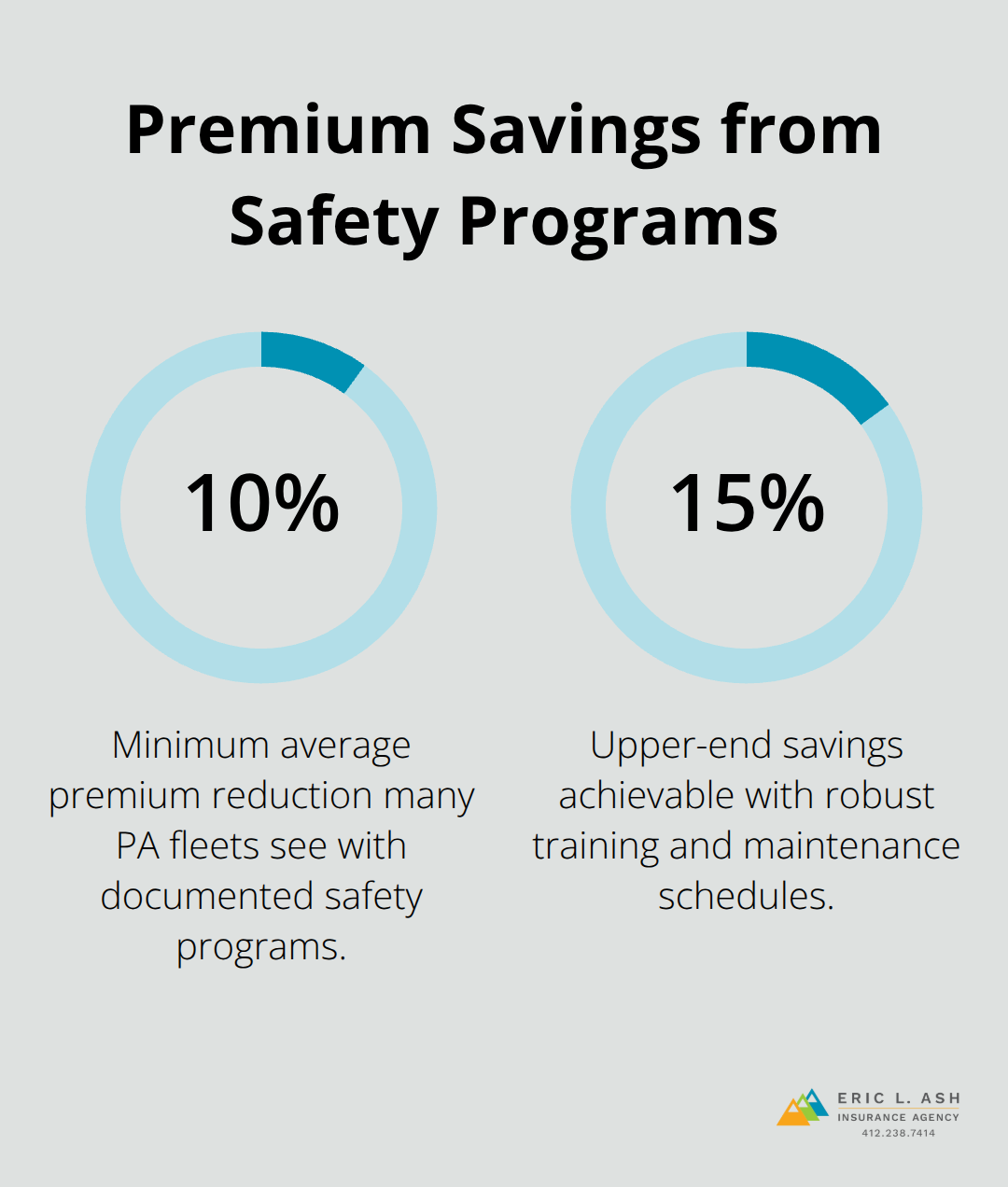
Implement a driver safety program-even a simple one with monthly safety meetings and clear vehicle maintenance standards-and you qualify for additional savings. Clean driving records for all your drivers matter enormously. A single at-fault accident or moving violation on an employee’s record can raise your premium by 10 to 30 percent, so make driver qualification standards part of your hiring process and monitor records annually. As an independent agency, we work with multiple top-rated insurance providers to identify which ones offer the best discounts for your specific safety practices and driver profiles. This approach helps small business owners access rates that reflect their actual risk, not just industry averages.

Your next step involves understanding what coverage options actually protect your fleet and which ones you can safely skip.

What Coverage Actually Protects Your Fleet

Liability Coverage: Your First Line of Defense

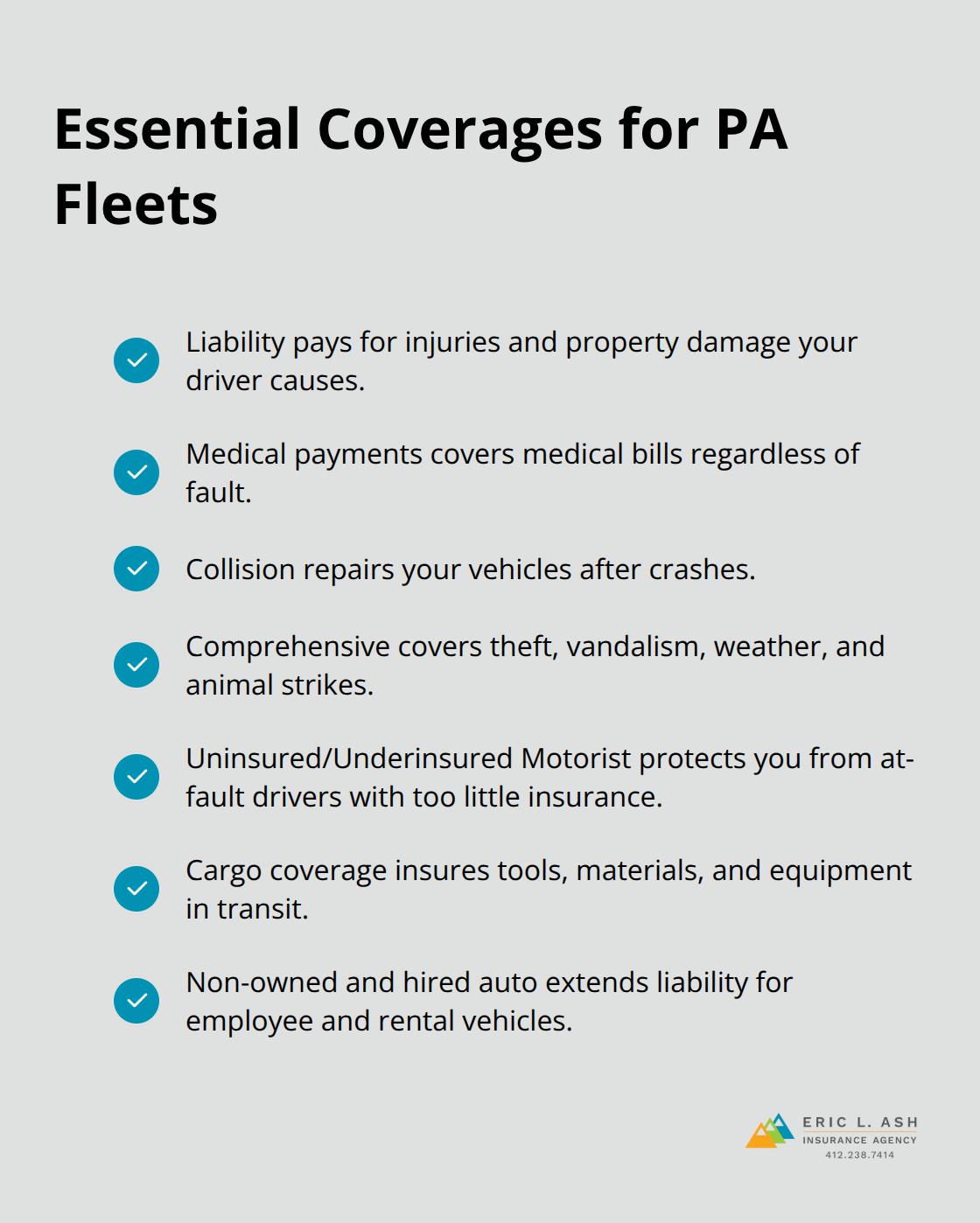
Liability coverage forms the foundation of commercial auto insurance, and it’s the only coverage most states legally require. This coverage pays for medical expenses and property damage when your driver causes an accident-it protects the other person, not your vehicle. State minimum liability limits vary widely. Some states require as little as $15,000 in bodily injury coverage per person, while others demand $50,000 or more. These minimums are dangerously low for small businesses. A single serious injury claim can exceed $100,000 in medical costs alone, and if your coverage limit is only $25,000, you personally owe the remaining $75,000. Courts can garnish your business income for years to satisfy a judgment.

Carry at least $100,000 per person and $300,000 per accident in bodily injury liability, plus $100,000 in property damage liability. These higher limits cost only slightly more than minimums but protect your business assets from catastrophic claims. If you operate multiple vehicles or employ drivers, the additional premium for adequate liability limits pays for itself through protection.

Collision and Comprehensive: Protecting Your Own Vehicles

Collision and comprehensive coverage protect your own vehicles, not third parties. Collision pays for repairs when your vehicle hits another car, object, or structure-regardless of fault. Comprehensive covers non-collision damage like theft, vandalism, weather, and animal strikes. Many small business owners skip comprehensive because they think their vehicles are low-risk, but this miscalculation often backfires. A food truck damaged by hail, a service van hit while parked, or equipment stolen from an unlocked vehicle represents lost revenue and repair costs you must absorb. The question isn’t whether damage will occur-it’s when.

Your deductible choice matters enormously for affordability. A $1,000 deductible costs significantly more than a $2,500 deductible, but only if you can actually afford to pay $2,500 out of pocket after an accident. Many small businesses choose deductibles they cannot afford, which defeats the purpose of having insurance.

Uninsured Motorist Coverage: Filling the Gap

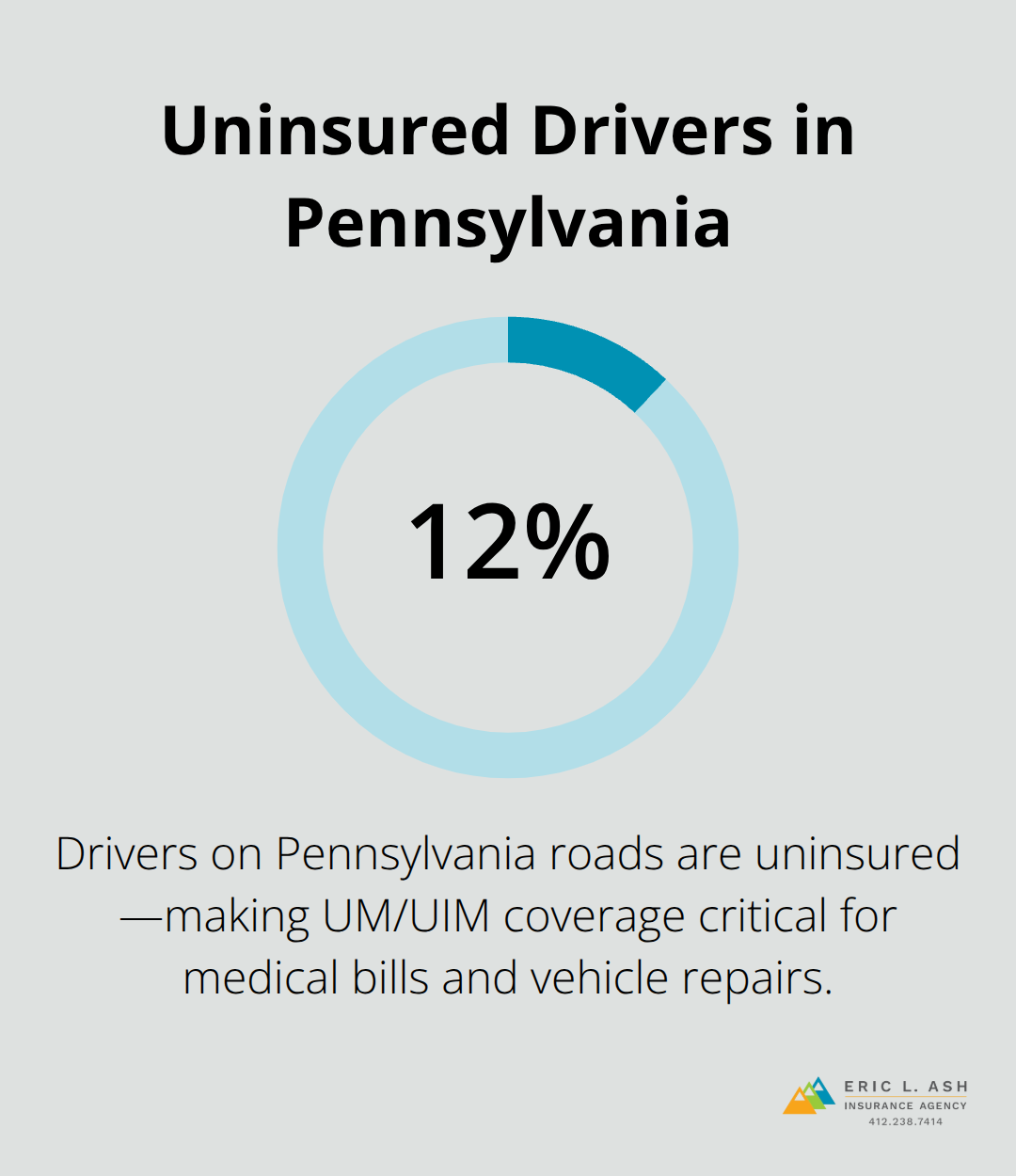
Uninsured motorist coverage protects you when another driver lacks adequate insurance or hits you and flees. According to the National Highway Traffic Safety Administration, roughly 13 percent of drivers nationwide carry no auto insurance, and in some states that number exceeds 20 percent. If an uninsured driver injures your employee or damages your vehicle, your uninsured motorist coverage steps in to cover medical expenses and repairs up to your policy limits.

Percentage of drivers nationwide without auto insurance, illustrating why uninsured motorist coverage matters. - small business commercial auto

This coverage is inexpensive-typically $50 to $150 annually depending on your limits-and it fills a critical gap that liability coverage cannot address. Skipping uninsured motorist protection is a false economy that leaves your fleet vulnerable to the growing number of uninsured drivers on the road.

Final Thoughts

Affordable small business commercial auto insurance requires three concrete actions: comparing multiple quotes, bundling policies strategically, and implementing driver safety practices that reduce your actual risk. Most small business owners overpay because they accept the first quote they receive or fail to ask about discounts that stack on top of bundled rates. The carriers you choose matter less than the effort you invest in shopping around and understanding your coverage needs.

Start by listing your vehicles and how you use them, then request quotes from at least three carriers with identical liability limits, deductibles, and coverage options. Ask each carrier what they’ll charge if you bundle commercial auto with general liability, property, or workers’ compensation, and track these numbers in a spreadsheet so you can see exactly where you save money. Once you’ve identified your lowest competitive rate, ask that carrier about safety training discounts, paperless billing discounts, and claims-free discounts that might apply to your business.

We at Eric L. Ash Insurance Agency work with multiple carriers to find competitive rates and tailored coverage for Pennsylvania small businesses. Contact us at ericlashagency.com to request a quote and compare your options for small business commercial auto protection.

The information provided in this blog is for general informational purposes only and does not constitute legal, financial, or insurance advice. Coverage options, terms, and availability may vary. Please consult with a licensed professional for advice specific to your situation.
Builder Risk Insurance: Protecting Construction Projects from Start to Finish

Builder Risk Insurance: Protecting Construction Projects from Start to Finish

Construction projects face constant threats from weather, theft, and accidents. Builder risk insurance protects your investment by covering property damage and losses during the building process.

At Eric L. Ash Insurance Agency, we know that one unexpected event can derail your entire project timeline and budget. The right coverage gives you peace of mind from groundbreaking to final inspection.

What Builder Risk Insurance Actually Protects

Builder risk insurance covers three critical areas that construction projects face daily: property damage from on-site events, theft and vandalism of materials and equipment, and weather-related destruction. Comprehensive coverage addresses damage from fire, lightning, hail, explosions, and acts of nature such as hurricanes. Your policy protects the building structure itself, all materials and supplies on site, equipment in transit to the job, and materials stored at other locations before installation. Soft costs matter too-many policies cover lost rental income, loan interest, and real estate taxes when weather delays push your timeline back.

Visualization of core builder risk insurance coverage areas for U.S. construction projects

Understanding Coverage Limits and Exclusions

The key is understanding what sits outside your coverage. Builder risk excludes earthquakes, floods, wind damage in certain coastal areas, and wear and tear from normal construction activity. Defective workmanship typically falls outside protection unless your policy includes an ensuing loss provision, which covers damage to other property caused by faulty installation work. Setting your coverage limits equal to your anticipated total construction cost prevents underinsurance; data shows the average builder’s risk premium runs about $1,259 per year for small businesses, with costs typically ranging from 1% to 4% of your total completed value.

How Location Impacts Your Premium

Location matters significantly-Florida and Texas premiums run higher than Colorado due to natural disaster risk, while proximity to fire stations and flood zones directly impacts your rate. Construction materials and quality influence risk as well; fire-resistive construction receives more favorable ratings than wood-frame structures. These factors combine to shape what you’ll pay for protection across your project phases.

Protecting Materials in Transit

Many contractors overlook coverage gaps when materials move between locations. Standard builder risk policies may not cover equipment and supplies traveling from supplier to job site, which means a truck accident or theft during transport leaves you unprotected. Inland marine insurance or contractor’s tools and equipment coverage fills this gap specifically for items in motion. Carriers offer extensions for scaffolding, temporary structures, and debris removal costs after a loss, which you should evaluate during the quote process.

Timing, Coinsurance, and Inflation Adjustments

Work with an agent who inventories all exposures across your project phases-site, in transit, and off-site storage-to identify whether targeted coverage or broader protection serves your needs better. Coverage starts when contracts are signed and ends at project completion or when the building reaches occupancy, so verify these exact triggers in your policy language before materials arrive. A 100% coinsurance clause appears in most policies, requiring you to insure at least the full replacement cost to avoid penalties on claims. Inflation adjustments matter; construction costs rise throughout your project, so revisit your insured value periodically to maintain adequate protection and avoid out-of-pocket losses when you file a claim. Understanding these mechanics positions you to select a policy that actually matches your project’s real exposure.

Why Your Project Needs Builder Risk Insurance

Without builder risk insurance, a single weather event or theft costs you tens of thousands of dollars in materials, labor, and project delays. Lenders and general contractors across the industry won’t move forward without proof of coverage, making this insurance a hard requirement rather than an option. Construction projects stall when owners underestimate their exposure or delay purchasing protection. The financial stakes are real: small business contractors pay around $1,259 annually for builder risk coverage, which represents genuine protection against losses that could exceed your entire project budget. Your lender requires coverage equal to the full construction cost before you break ground, and most general contractors demand proof that subcontractors carry their own policies. This layered approach protects everyone with a financial stake in the project.

Checklist of lender and contractor requirements plus financial reasons to carry builder risk insurance

Lenders Won’t Fund Without It

Banks and construction lenders make builder risk insurance a condition of financing, period. They need assurance that if a fire destroys the framing or a storm damages the roof, the insurance payment goes toward rebuilding rather than your personal bank account. Your loan agreement specifically names the lender as loss payee, meaning they receive claim payments directly. This protects their investment in your project and ensures you complete construction even after a major loss. Missing this requirement delays your entire financing timeline, and some lenders refuse to disburse funds until you provide a certificate of insurance showing active coverage.

Contractors and Subcontractors Demand Proof

General contractors require all subcontractors to carry builder risk insurance or be added as additional insureds on the project policy. This protects the general contractor from bearing the financial burden if your materials burn, get stolen, or suffer weather damage. Many construction contracts specifically state that subcontractors must maintain coverage throughout their work phase. If you show up without proof of insurance, you lose the job or face significant delays while you arrange coverage. The contractor’s own policy may not cover damage to your specific materials and tools, so separate coverage protects your financial interest.

Timeline Delays Cost Real Money

Construction delays from uninsured losses cascade quickly. A theft of copper wiring or HVAC equipment doesn’t just cost the materials; it delays your entire timeline, pushing back the occupancy date and triggering additional costs for extended financing, storage, and labor. Builder risk policies cover soft costs arising from a delay in project completion when delays extend beyond your anticipated completion date (these provisions prevent a weather event from becoming a financial catastrophe that extends your project months beyond schedule). Without this protection, you absorb every penny of delay costs out of pocket while your lender watches your completion date slip.

Choosing the Right Coverage for Your Situation

The decision to purchase builder risk insurance isn’t whether to buy it-your lender and contractors will require it-but rather how much coverage you need and which endorsements protect your specific project. Project size, location, construction materials, and timeline all influence what you should carry. Working with an insurance agent who understands construction exposes all the gaps that standard policies leave uncovered, from materials in transit to temporary structures on your site. The next section walks you through how to select a policy that actually matches your project’s real exposure rather than settling for whatever quote arrives first.

How to Choose the Right Builder Risk Policy

Calculate Your Coverage Limit Accurately

Start with your total construction cost down to the penny, then add 10-15% for inflation and unexpected material price increases during your project timeline. This number becomes your coverage limit baseline, and underestimating it creates serious problems when you file a claim.

Three-step guide to calculating builder risk coverage limits and avoiding coinsurance penalties

Coinsurance penalties hit hard: if you insure a $500,000 project for only $400,000 and suffer a $50,000 loss, your insurer calculates the claim as if you’re responsible for 20% of all losses, meaning you collect just $40,000 instead of the full $50,000. Work backward from your architect’s cost estimate and construction schedule to lock in the right limit before you purchase a policy. Your lender will demand proof that your coverage limit equals the full construction cost anyway, so this isn’t optional.

Map All Exposures Across Your Project Phases

Inventory every exposure across your project phases: materials stored on-site, equipment arriving at the job, supplies sitting at off-site warehouses, and temporary structures like scaffolding and tool sheds. Most standard builder risk policies cover on-site damage but create gaps for coverage for materials in transit or stored away from the job. If your subcontractors deliver materials directly to your site, standard coverage usually protects them. But if you stage materials at a warehouse across town before installation, you need explicit coverage for that location. Request quotes that include extensions for debris removal, temporary structures, and ensuing loss provisions that cover damage to other property caused by faulty workmanship. These endorsements cost extra but prevent expensive surprises when a covered peril damages something your base policy doesn’t mention.

Compare Quotes Side-by-Side on Coverage, Not Just Price

Obtain quotes from at least three carriers before selecting a policy, but don’t just compare the monthly premium. Compare the coverage limits, deductibles, and exclusions side-by-side because a cheaper policy often excludes perils that matter to your specific project. A $50 monthly difference across a 12-month project saves just $600, but missing coverage for theft or water damage could cost $50,000 or more. Ask each carrier explicitly whether their policy covers materials in transit, scaffolding, temporary structures, and soft costs from project delays. Document their answers in writing because verbal assurances disappear when you file a claim. Request sample policies before committing, and read the exclusions section carefully-that’s where carriers bury the gaps that will hurt you. Pay special attention to how each policy defines your anticipated completion date, since coverage ends at completion or when the building becomes occupied, whichever comes first. A policy that ends 30 days after your anticipated completion date leaves you exposed if your project runs long.

Select a Deductible That Protects Your Cash Flow

Your deductible choice directly impacts your monthly premium: a $500 deductible costs significantly less than a $1,000 deductible, which costs less than a $2,500 deductible. Try a deductible you can actually afford to pay out-of-pocket without disrupting your project cash flow, because that’s what you’ll pay before your insurance kicks in. For most construction projects, a $1,000 deductible strikes the right balance between keeping premiums manageable and retaining enough coverage to matter. If your project involves high-value equipment or materials in transit regularly, a lower deductible protects you better against frequent small losses. If you’re building a simple structure with minimal materials on-site, a higher deductible reduces your monthly costs without sacrificing meaningful protection. Never select a deductible based solely on getting the cheapest monthly payment-that penny-wise approach costs dollars when you file a claim.

Final Thoughts

Builder risk insurance protects your investment from the moment contracts are signed through final occupancy, and without it, a single weather event or theft becomes a financial catastrophe that drains your budget. Your lender demands it, your contractors require it, and your project’s success depends on having adequate coverage in place before materials arrive on site. The coverage you select today determines whether unexpected losses get absorbed by insurance or by your bank account.

Proper builder risk insurance means calculating your limits accurately, mapping every exposure across your project phases, and selecting endorsements that close gaps standard policies leave open. You need to understand your deductible choice, verify your completion date triggers, and maintain inflation adjustments as construction costs rise throughout your project. The difference between adequate protection and inadequate coverage often comes down to whether you worked with someone who understands construction or simply accepted the first quote that arrived.

Contact Eric L. Ash Insurance Agency to discuss your project’s coverage needs and get quotes from carriers with real construction expertise. We work with construction professionals across Pennsylvania to build builder risk policies that match your actual project exposure rather than settling for generic coverage. Your next step is straightforward: reach out to an insurance professional who understands construction and can inventory your specific exposures so your project stays protected from groundbreaking to completion.

The information provided in this blog is for general informational purposes only and does not constitute legal, financial, or insurance advice. Coverage options, terms, and availability may vary. Please consult with a licensed professional for advice specific to your situation.
Airbnb Rental Insurance: Protecting Your Short-Term Space

Airbnb Rental Insurance: Protecting Your Short-Term Space

Your standard homeowners policy won’t cover your Airbnb income or protect you from guest-related accidents. That gap leaves you exposed to serious financial risk.

At Eric L. Ash Insurance Agency, we see hosts discover this problem too late. Airbnb rental insurance fills those gaps with coverage designed specifically for short-term rental operators.

Why Your Homeowners Policy Leaves You Exposed

Standard homeowners policies were written for owner-occupied homes, not businesses. The moment you list your property on Airbnb, you’ve crossed into commercial activity that most traditional policies explicitly exclude. Insurance companies know the difference between a family living in a home and a host running a vacation rental operation with constant guest turnover, and they price accordingly-or they don’t cover you at all.

Most homeowners policies contain a business exclusion clause that voids coverage for income-generating rental activity. This isn’t a gray area or a technicality. If you file a claim related to your Airbnb operation and your insurer discovers you were running a short-term rental, they can deny the entire claim. You lose not just the coverage you thought you had, but also the premium you’ve been paying.

The Income Problem Nobody Talks About

Your homeowners policy will not reimburse you for lost rental income. If a fire damages your property and you can’t accept guests for three months, your policy covers the structure and contents-but not the income you had to forgo. Short-term rental hosts depend on that income as a primary revenue stream for many properties.

A covered loss that makes your property uninhabitable means zero income during recovery, and your homeowners policy won’t replace a single dollar of that lost revenue. This gap forces many hosts to choose between reconstruction costs and survival, and it’s entirely preventable with the right coverage.

Liability Exposure Extends Beyond Your Walls

Standard homeowners liability coverage typically maxes out at $300,000 to $500,000 and assumes a family household, not a business with dozens of rotating guests annually. When a guest is injured on your property or claims damage from something they brought with them, the liability exposure multiplies.

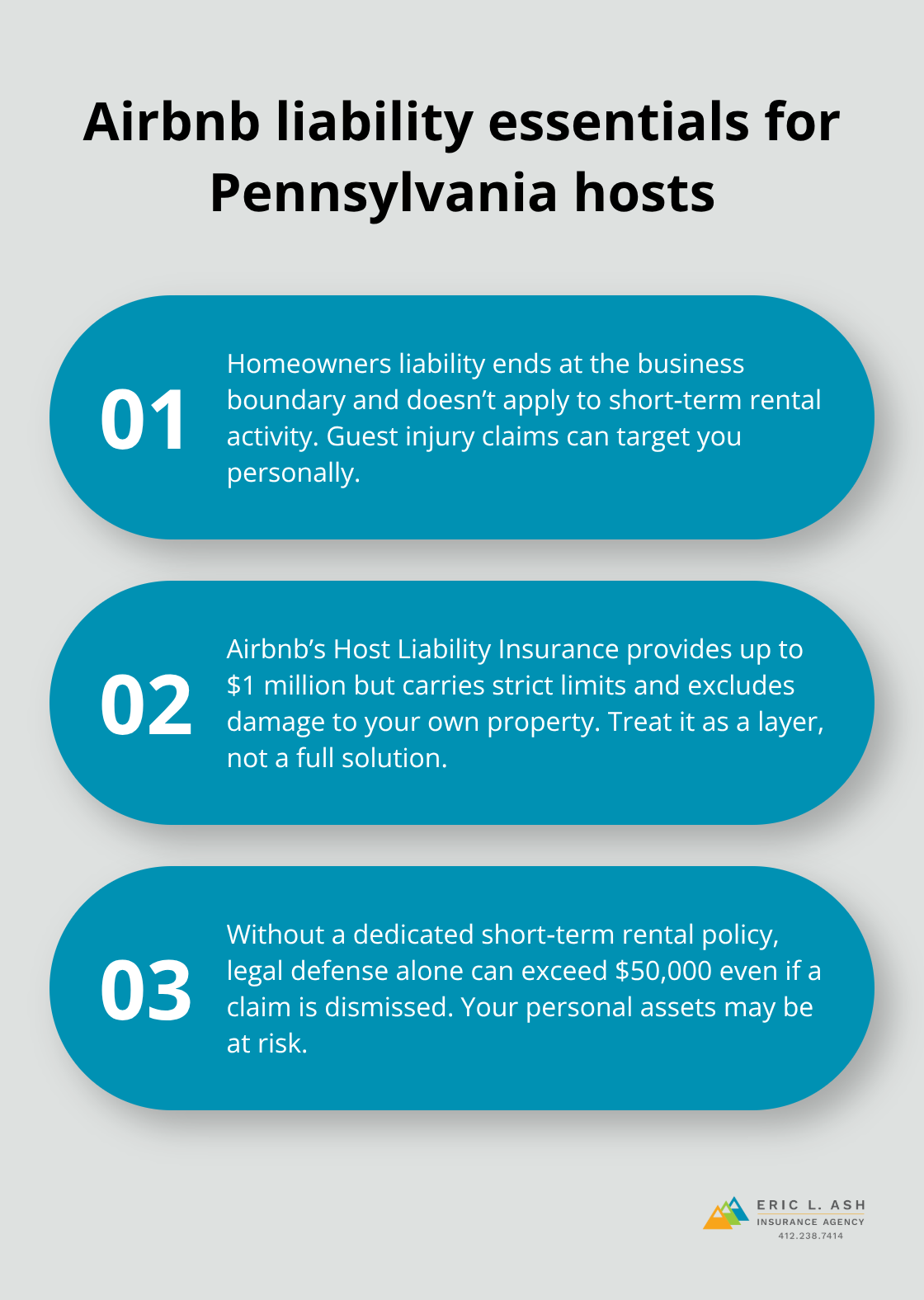
A guest who slips on your deck and breaks their leg, a guest whose friend is injured using your hot tub, or a guest who causes property damage at a neighboring property while using your kayak-all of these scenarios create liability that extends far beyond what homeowners insurance contemplates. Airbnb’s Host Protection Insurance provides up to $1 million per occurrence for liability, but it has critical exclusions. It does not cover mold, pollution, certain water damage, or property damage to your own rental. Host Protection also does not cover lost income.

Relying solely on Airbnb’s program leaves significant gaps, particularly around property damage claims and business interruption. Your homeowners policy won’t fill those gaps because the business exclusion clause already removes your commercial operation from coverage entirely. This combination of gaps-income loss, property damage, and extended liability-is exactly what specialized Airbnb rental insurance addresses.

What Airbnb Rental Insurance Covers

Property Damage from Guests

Specialized Airbnb rental insurance replaces the gaps left by your homeowners policy with coverage designed for the realities of short-term hosting. Unlike traditional policies that exclude your rental operation entirely, these policies acknowledge that you run a business and build protection around the specific risks that come with it.

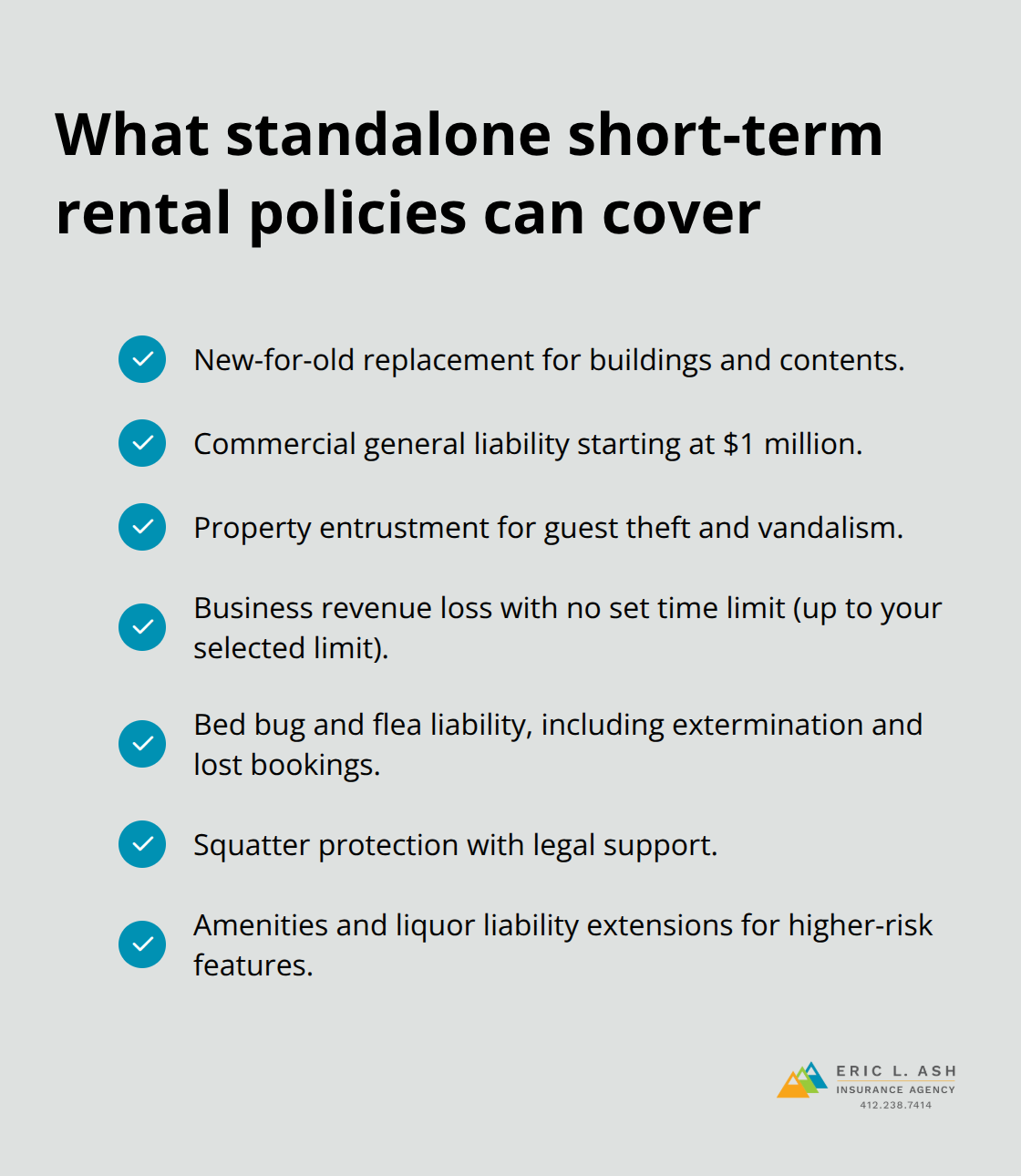
Property damage from guests tops the list. When a guest damages your furniture, breaks appliances, or causes structural damage, your homeowners policy won’t pay because the business exclusion clause already removed you from coverage. Airbnb rental insurance covers guest-caused damage to your building and contents using replacement cost valuation, which means you receive payment for what it costs to replace items new, not what they’re worth after depreciation.

Proper Insurance covers all-risk building and contents with no sub-limits on theft, vandalism, or water damage. This matters because a single incident involving intentional guest destruction or water damage could easily exceed $10,000, and you need coverage that doesn’t cap payouts for specific claim types.

Four key protections Airbnb hosts get beyond standard homeowners policies

Host Liability for Guest Injuries

Host liability for guest injuries represents your second major exposure, and it’s where platform protection falls dangerously short. While sites like Airbnb do offer some property protection for hosts against damage by a guest, it does not include liability insurance. Airbnb’s Host Protection Insurance caps liability at $1 million per occurrence, but it explicitly excludes mold, pollution, and certain water damage claims.

Real Airbnb rental insurance extends liability coverage to incidents both on and off your property. If a guest suffers injury using your kayak three miles away at a local lake, that coverage applies. If a guest experiences a bed bug infestation and files a liability claim, that coverage applies too, including extermination costs and lost revenue from canceled bookings. Commercial General Liability in specialized policies starts at $1 million per occurrence with options up to $2 million, addressing the expanded exposure that comes with rotating guests.

Business Interruption Coverage

The third critical piece is business interruption coverage, which homeowners insurance explicitly won’t provide. If a covered event like fire or water damage makes your property uninhabitable, this coverage reimburses your actual lost rental income with no time limit on payouts.

For hosts earning $2,000 to $5,000 monthly from their property, three months of lost income while repairs happen represents $6,000 to $15,000 in unrecovered revenue. Specialized policies cover this gap entirely, protecting your cash flow when you need it most.

Scheduled Coverage for High-Value Items

High-value items deserve scheduled coverage. If you furnish your rental with expensive artwork, electronics, or designer pieces, standard coverage often applies sub-limits that leave you underprotected. Adding scheduled personal property coverage to your Airbnb rental insurance means each valuable item gets listed individually with its full replacement cost guaranteed, eliminating depreciation calculations and sub-limit surprises when you file a claim.

When you understand what specialized coverage actually protects, the next step involves comparing specific policies and providers to find the right fit for your property’s unique characteristics and occupancy patterns.

Selecting the Right Coverage for Your Rental Property

Calculate Your True Replacement Cost and Occupancy Rate

Start with your actual replacement cost, not your purchase price. Many hosts underestimate what it would cost to rebuild their property today, which leads to insufficient coverage limits. If your rental cost $300,000 to purchase but would cost $450,000 to rebuild with current labor and material prices, your coverage limit should reflect the higher figure.

Occupancy patterns matter equally. A property that hosts guests 200 nights annually faces different risk exposure than one occupied 100 nights yearly. Properties with higher turnover see more guest-caused damage, theft, and liability incidents. When you request quotes, provide accurate occupancy data because insurers price based on exposure frequency.

Compare Pricing Across Multiple Providers

CBIZ Vacation Rental Insurance and Safely both tailor quotes to specific occupancy rates. CBIZ reports plans ranging from about $3 per day to roughly $100 per month depending on property characteristics. Safely offers customized pricing based on stay length, number of properties, occupancy, and deductible selection, with 98% of claims paid within 4 to 5 days. This speed matters when you need cash flow restored quickly after a loss.

Safely pays 98% of claims within 4–5 days - Airbnb rental insurance

Proper Insurance covers all 50 states plus Washington, D.C., and includes squatter protection with legal support and lost revenue coverage if a guest refuses to vacate, plus bed bug and flea protection covering extermination costs and booking cancellations. Truvi offers global coverage outside travel-advisory countries with payouts in 3 to 5 days and pricing starting around £13.80 per booking.

Evaluate Coverage Details Beyond Premium Amounts

Compare what each provider actually covers rather than focusing solely on premium. CBIZ covers all 50 states plus Puerto Rico, Washington, D.C., and the U.S. Virgin Islands, with $2 million general liability and legal expense coverage for squatter situations. Allstate HostAdvantage provides guest-damaged personal property protection up to about $10,000 per rental period in select states.

Key factors for selecting the right short-term rental insurance policy - Airbnb rental insurance

The exclusions matter more than the coverage limits. Ask specifically whether the policy covers water damage without sub-limits, whether bed bug claims include lost revenue, and whether liability extends to guests using amenities off-site (kayaks, bikes, pools). These details separate adequate protection from policies with hidden gaps that emerge only when you file a claim.

Final Thoughts

Your standard homeowners policy excludes your rental operation entirely, and that exclusion removes coverage the moment you accept your first guest. Airbnb rental insurance fills this gap with replacement cost protection for guest-caused damage, liability coverage that extends beyond your property boundaries, and business interruption protection that replaces lost income during recovery. Providers like Proper Insurance, CBIZ, and Safely have built policies specifically around the operational realities of short-term hosting, including protections for bed bugs, squatters, and amenity-related incidents that traditional insurers either exclude or severely limit.

The right coverage depends on your specific property, occupancy rate, and the amenities you offer. Comparing quotes across multiple providers reveals significant differences in what you actually get for your premium-a policy that costs $50 monthly might exclude water damage sub-limits or cap bed bug coverage, while another at a similar price includes unlimited protection for those same risks. The details matter far more than the headline premium.

We at Eric L. Ash Insurance Agency work with hosts across Pennsylvania to find Airbnb rental insurance that matches their operations without leaving dangerous gaps. As an independent agency, we shop multiple carriers to deliver competitive rates and tailored protection backed by responsive local service. Contact us to review your current coverage and explore specialized options that actually protect your investment and income.

The information provided in this blog is for general informational purposes only and does not constitute legal, financial, or insurance advice. Coverage options, terms, and availability may vary. Please consult with a licensed professional for advice specific to your situation.

The Journey, Part II: Community Service

There’s always something special about the journey.

Over a decade ago, when I started in the insurance business as a new small business owner, I was searching for ways to connect with the surrounding communities. As I explored different civic organizations — the Lions Club, Rotary Club, and local business networking groups — I realized these groups offered the opportunity to do more good, on a larger scale, than I could ever accomplish alone.

That realization led me to join the Rotary Club of Elizabeth, an organization with more than 50 years of service in our community. Rotary’s mission, “Service Above Self,” resonated deeply with me, and I quickly saw that our local club lived out that motto through projects that supported food banks, Meals on Wheels, and other local nonprofits. What drew me in most, though, was the club’s strong partnership with the Elizabeth Forward School District (EFSD).

That relationship is especially meaningful because of its impact at every level of the school district. What began with the high school Interact Club (a student version of Rotary) and the five annual Community Service Awards presented to deserving EFHS seniors has grown into so much more. Our club proudly supports the #DictionaryProject, providing every third grader in the district with their own dictionary. About eight years ago, we also launched the third-grade spelling bee, which now draws 60–70 enthusiastic participants each year.

In 2025, we’re expanding our partnership even further — working with Elizabeth Forward Middle School to support mentorship and esports programs.

Today, I’m honored to serve as Co-President of the Elizabeth Rotary Club, a role I’ve held for the past few years. If you’re looking for a way to give back and make a difference in your community, I encourage you to give Rotary a try.

We meet on the 1st and 3rd Thursdays of each month at noon at The Carriage Inn. We’d love to have you join us.

Here’s to the next decade of Rotary service — and the journey that continues to inspire us all.

The Journey

“It is good to have an end to journey towards; but it is the journey that matters, in the end.” — Anonymous

Lily setting out on another bike adventure along the Great Allegheny Passage heading towards Pittsburgh

The journey I think about is in my recent past, more specifically the last twelve years.

Everyone’s career arc is different. You often hear, “I never dreamt in my wildest dreams I’d be where I am today when I look back on what I studied in school.” In my case, I spent almost fifteen years after college working as a public relations professional, steadily climbing the corporate ladder. At some point, that arc hit a ceiling, and downsizing and the imminent closure of the agency I worked at loomed on the horizon. This was a pivotal turning point. On one hand, it was hard to give up what seemed to be my lifelong career path; on the other, the thought of starting over was scary to contemplate.

Eventually, I chose the latter. It became not only a challenge to become a first-time small business owner, but also an opportunity to dive into a whole new world of insurance education. What made the decision easier were two things:
  1. Being closer to home to make childcare a little easier
  2. Most importantly, being able to spend time with my preschool-aged daughter

The two of us spent the better part of a few months enjoying the crisp fall weather while adventuring outdoors—bike rides, hikes, geocaching, and more. As the weather grew chillier, we moved indoors to rock climbing, ice skating (most days just the two of us on the sheet of ice), visiting museums, and so on. What made this time so special was simply being together. It seems like only yesterday, yet now twelve years have passed. I wouldn’t trade that time for the world—it wasn’t about jumping into the next job or being away from family with a city career. It was about being there for my daughter and building a relationship.

So, what does this have to do with selling insurance, you may ask? This “new” career path has given me the chance to be present for life’s special moments with my family—whether traveling, cheering at my daughter’s first ice hockey game, a golf match, or a cross-country meet. It has allowed me to enjoy watching the little girl in the cute cat bike helmet grow into a beautiful young woman with lofty dreams and an amazing soul.

Sometimes the destination isn’t what you expect or can predict, but it’s the journey along the way that shapes who we are, how we view success, and how we evaluate one’s life’s work.


Enjoy the journey,

Eric

Why Choose a Local Independent Insurance Agency Over a Large Corporate Broker

Why Choose a Local Independent Insurance Agency Over a Large Corporate Broker

Why Choose a Local Independent Insurance Agency Over a Large Corporate BrokerWhen it comes to protecting what matters most — your home, your car, your business, and your family — choosing the right insurance partner makes all the difference. At the Eric L. Ash Insurance Agency, we believe there’s real value in working with a small, independent agency versus a large, corporate-style organization. Here’s why:
  1. Personalized Customer Service🤝

With a smaller, independent agency, you’re not just a policy number. You’re a neighbor, client, and partner.

  • Direct Access: You know who you’re calling, and we know your story.
  • Responsive Support: No endless call centers or long hold times — just real people ready to help.
  • Relationships First: We build long-term connections, not one-time transactions.
  1. More Choices, Better Coverage🛡️

As an independent agency, we aren’t tied to a single carrier or pressured to sell one company’s products.

  • We work with multiple top-rated insurance providers.
  • We shop around to find the best combination of price and coverage.
  • You get tailored solutions that fit your needs — not a one-size-fits-all policy.
  1. Advocates, Not Salespeople📞

Large corporate organizations often prioritize volume, but we focus on your best interest.

  • We act as your advocate when filing claims.
  • We’re here to explain your options clearly and honestly.
  • Our goal is to protect your assets, not meet a quota.
  1. Local Knowledge, Community Focus🌟

Because we live and work where you do, we understand your community’s unique risks and needs.

  • Whether it’s local weather patterns, regional regulations, or neighborhood-specific concerns, we have first-hand insight.
  • We also invest back into the community — sponsoring events, supporting nonprofits, and being part of the fabric of where we live.
  1. Consistency You Can Count On

With large corporate brokers, staffing changes and high turnover can leave you explaining your situation to a new representative every time you call. At the Eric L. Ash Agency, you’ll always work with a familiar, reliable team who knows your history and priorities.

The Bottom Line

Choosing a small independent agency like the Eric L. Ash Insurance Agency means choosing:

  • Personalized service
  • More carrier options
  • Local expertise
  • A true advocate when you need one most

When it comes to your peace of mind, bigger isn’t always better.

📞 Ready to experience the difference? Call us today at 412-238-7414 or visit www.ericlashagency.com to get started.

Business Insurance 101: Protecting What You’ve Built

Running a business is exciting — but it also comes with risks. At the Eric L. Ash Insurance Agency, we believe every business owner deserves the peace of mind that comes from knowing they’re covered, no matter what comes their way. If you’ve ever wondered what types of business insurance you might need, here’s a quick guide to the core coverages that can protect your livelihood and help your company thrive.

  1. General Liability Insurance

General liability is your first line of defense. It protects your business if someone is injured on your property or if you’re held responsible for property damage. It can also help cover legal fees. Without it, one accident or lawsuit could seriously impact your business’s finances.

  1. Business Personal Property Insurance

Think about everything your business owns — furniture, equipment, computers, inventory. Business personal property insurance covers these assets against risks like fire, theft, or certain types of water damage. This coverage can help you replace essential items quickly so your operations can continue with minimal downtime.

  1. Building Coverage

If you own the building your business operates from, commercial building coverage is a must. It protects the structure itself against damage from events like fire, storms, vandalism, or certain natural disasters. Without it, repairing or rebuilding after a loss could be financially devastating.

  1. Commercial Umbrella Insurance

An umbrella policy provides an extra layer of protection above and beyond your other liability limits. It’s designed for those “worst-case scenarios” when a claim exceeds the coverage on your primary policies. Umbrella insurance can help protect your business from major financial setbacks.

  1. Commercial Auto Insurance

If you or your employees drive for business purposes — delivering goods, traveling to job sites, or meeting clients — commercial auto insurance is essential. It covers damage to your vehicles, injuries, and liability for accidents. Personal auto policies typically won’t cover business use, so having commercial auto coverage is critical.

  1. Workers’ Compensation Insurance

If you have employees, workers’ compensation insurance is more than just smart — in most states, it’s legally required. It covers medical expenses and lost wages if an employee is injured or becomes ill due to work. It’s a way to take care of your team while also protecting your business from costly lawsuits.

Bottom Line:
Every business is unique, and so are its commercial insurance needs. At the Eric L. Ash Insurance Agency, we take the time to understand your operations and recommend the right combination of coverages — from general liability to workers’’ compensation coverage — to keep your business safe.

📞 Call us today for a no-obligation business insurance review and find out why so many business owners in Western Pennsylvania us to protect what they’ve built.

Why Every Renter Needs Insurance

Why Every Renter Needs Insurance — Especially College Students

Why Every Renter Needs Insurance — Especially College Students

By the Eric L. Ash Agency

Why Every Renter Needs InsuranceWhether you’re a young professional renting your first place or a college student moving into off‑campus housing, renters insurance is a smart and affordable way to protect what matters most. At the Eric L. Ash Agency, we believe in empowering renters with the knowledge they need to stay financially secure.

4 Key Reasons to Have Renters Insurance

Here are the top reasons renters need their own policy—landlord coverage doesn’t protect personal belongings or liability:

  1. Protect Your Personal Belongings
    Items like laptops, clothing, furniture, and bikes aren’t covered by a landlord’s insurance policy. A renters policy reimburses you if they’re damaged or stolen—whether it’s from fire, theft, or vandalism.
  2. Liability Coverage
    If a visitor injures themselves in your rental or you cause damage to someone else’s property, renters insurance can cover legal and medical fees. Even common scenarios—your pet biting someone, a cookout that gets out of hand—can lead to costly liability exposure without insurance.
  3. Additional Living Expenses
    If your rental becomes uninhabitable after a fire or water damage, your renters policy can cover temporary housing and related expenses. That way you can focus on recovery, not unexpected hotel bills or meals out.
  4. Worldwide Personal Property Coverage
    If your laptop or phone is stolen while you’re traveling, renters insurance may still cover it—though limits may apply. Always check policy details before you leave home.

Why College Students Living Off Campus Should Have It Too

College students—especially those in off-campus apartments—are often overlooked when it comes to insurance, but here’s why coverage is just as critical:

📘 Your parents’ homeowners policy may not extend
Many assume that their family’s homeowners insurance will cover them in a rental—but that policy typically doesn’t extend to off-campus housing. Without renters insurance, students are unprotected financially.

💼 Belongings are valuable and vulnerable
Laptops, textbooks, guitars—all add up. Even modest possessions can cost thousands to replace.

👥 Roommate policies bring complications
Sharing one policy may seem cost-effective, but it creates complications if roommates move out, file claims, or disagree over reimbursement. Experts recommend that roommates hold separate policies to avoid coverage gaps and disputes.

How Affordable Is Renters Insurance?

  • Premiums average just $12–30/month depending on coverage limits, location, and discounts.
  • That’s about $150–300/year for protection across several critical coverage areas.
  • Many insurers—offer discounts for bundling with auto insurance or using smart security systems like smoke alarms or burglar alarms.

Coverage Essentials: What to Look For

Coverage Type Why It Matters
Personal Property Replaces items due to fire, theft, or covered damage
Replacement Cost Coverage Ensures full value replacement rather than depreciated cash value
Liability Protection Covers injuries or damages you’re legally responsible for
Loss of Use / ALE Pays housing or living costs if your rental is uninhabitable
Personal Belongings Away from Home Protects gear on vacation or school trips (within policy limits)

✅ Ready to Protect Your Stuff and Your Wallet?

At the Eric L. Ash Agency, we specialize in helping renters—students and otherwise—get reliable, affordable coverage tailored to their lifestyle:

  • We’ll walk you through policy options, including replacement cost vs. actual cash value coverage
  • Help you assess deductible choices and limits
  • Review available discounts, like multi‑policy savings and home-safety features
  • Assist you with questions about claims, coverage exclusions, and filing procedures

Let’s Get Started

Contact the Eric L. Ash Agency today to get a customized renters insurance quote and protect your personal property and liability—without breaking the bank.

📞 Call us at 412-238-7414
📧 Email:  eric@ericlashagency.com
🌐 Visit:  www.ericlashagency.com/quote

Eric L. Ash Agency

Buying a New Home? Here's What You Need to Know About Insurance

Buying a New Home? Here’s What You Need to Know About Insurance

Buying a New Home? Here's What You Need to Know About InsuranceBy:  Eric L. Ash Agency

Congratulations! Buying a new home is one of life’s most exciting milestones. Whether you’re a first-time buyer or upgrading to your dream home, it’s a major investment — and one worth protecting. At the Eric L. Ash Agency, we know the home-buying process can feel overwhelming, especially when it comes to understanding your insurance needs. Here are a few essential tips to help you feel confident and covered from day one.

🔍 1. Start Thinking About Insurance Early

Don’t wait until closing day to think about homeowners insurance. Most lenders require proof of insurance before the mortgage is finalized, so it’s important to shop around early. Working with a local agent (like us!) means you’ll get personalized guidance and the right coverage tailored to your specific home and location.

🧾 2. Know What Your Policy Covers (and What It Doesn’t)

A standard homeowners insurance policy typically covers:

  • The structure of your home
  • Personal belongings
  • Liability protection
  • Additional living expenses (if you need to temporarily relocate)

However, things like floodingearthquakes, or sewer backups often require separate policies or add-ons. We’ll walk you through what’s included and recommend extra protection if your home needs it.

💰 3. Consider the Right Amount of Coverage

Don’t just go for the cheapest policy. You want to be sure your coverage reflects the replacement cost of your home—not just the market value. We’ll help you estimate the right amount so that you’re not underinsured when it matters most.

🏘 4. Factor in Location-Based Risks

Every area has its own risks—Allegheny County, for example, may be prone to weather-related issues or flooding in certain neighborhoods. We’ll review the local data to make sure you’re covered for the risks most relevant to your new home.

🧯 5. Ask About Discounts

Did you know you could save on your policy by bundling home and auto insurance? Or by having a security system, smoke detectors, or a new roof? At the Eric L. Ash Agency, we make sure you’re not leaving any savings on the table.

✅ 6. Keep Your Policy Up to Date

Buying a home is just the beginning. As you make updates or renovations, let us know. Even things like installing a deck or finishing a basement could affect your coverage needs.

Let’s Make Insurance Simple

At the Eric L. Ash Agency, we’re here to make the insurance side of homeownership as stress-free as possible. If you’re in the process of buying—or just closed on a new place—reach out today. We’ll help you protect your investment and give you peace of mind for years to come.

📞 Call us at 412-238-7414
📧 Email: eric@ericlashagency.com

🌐 Visit: www.ericlashagency.com

Eric L. Ash Agency
Protecting What Matters Most.